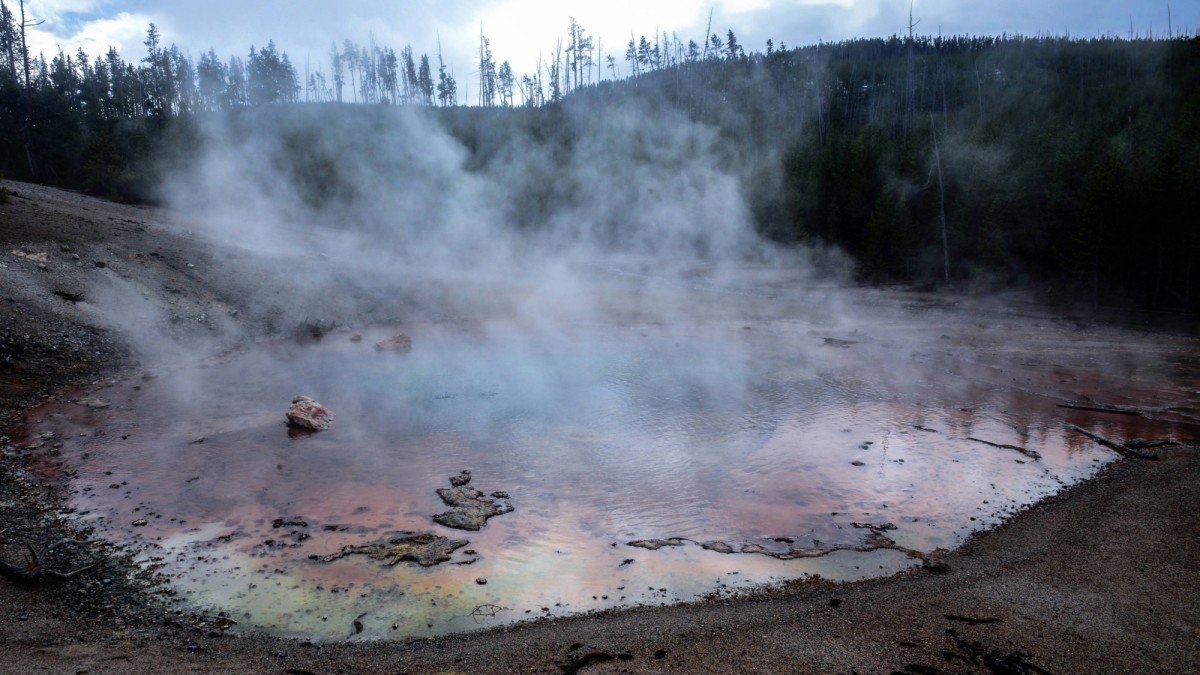
Yellowstone National Park’s Echinus Geyser, the world’s largest acidic geyser, has reawakened after a six-year period of dormancy. The eruptions, which began in early February, send jets of hot, acidic water up to 30 feet into the air, showcasing the raw geothermal power of the Norris Geyser Basin in Wyoming. This resurgence highlights the unpredictable nature of Yellowstone’s hydrothermal system—one of the most dynamic on Earth.
The Chemistry of an Acidic Eruption
Acid geysers are rare because highly acidic water tends to dissolve the rock formations that support geyser structures. Echinus, however, survives because its acidic water results from a unique mix of acidic gases and neutral waters. The resulting acidity is strong enough to create unusual formations, vibrant colors, and even some danger. The red hues around the geyser pool and the spiny, silica-covered rocks are caused by high concentrations of iron, aluminum, and arsenic.
The water’s acidity is comparable to orange juice or vinegar, but temperatures can exceed 200°F, making caution essential for visitors. The Norris Geyser Basin is also home to Steamboat Geyser, the world’s tallest active geyser, making it a hotspot for geothermal activity.
A History of Volatility
Echinus’ activity has fluctuated significantly over the decades. Initially dormant until 1948, the geyser entered a period of regular eruptions in the 1970s, occurring every 40 to 80 minutes. This escalated in the 1980s and 1990s, with eruptions lasting over 90 minutes. By the early 2000s, activity waned as temperatures decreased.
A notable resurgence occurred in the fall of 2017, with consistent eruptions every two to three hours. This lasted until November 2017, followed by isolated events in 2018, 2019, and two in December 2020. The current activity mirrors the pattern observed in 2017, with eruptions repeating every two to five hours, each lasting two to three minutes.
Monitoring the Activity
Geologists and visitors can monitor the geyser’s behavior through temperature graphs on the Yellowstone Volcano Observatory website. Spikes at 158°F indicate eruptions, while surges at 104°F are precursors. While these eruptions are unlikely to continue into the peak summer tourist season, they serve as a reminder of the powerful, unpredictable forces shaping Yellowstone.
The reawakening of Echinus Geyser underscores the dynamic nature of geothermal systems and the importance of continued monitoring. Yellowstone’s hydrothermal features are not static; they change, erupt, and evolve in ways that capture the raw energy of the planet.