Dinosaurs were apex predators of their time, with species like Tyrannosaurus rex weighing up to 15,500 pounds and Giganotosaurus reaching the size of a city bus. The idea of these giants possessing venom adds another layer of terror, but paleontological evidence suggests that venomous dinosaurs may be more Hollywood fantasy than prehistoric reality.
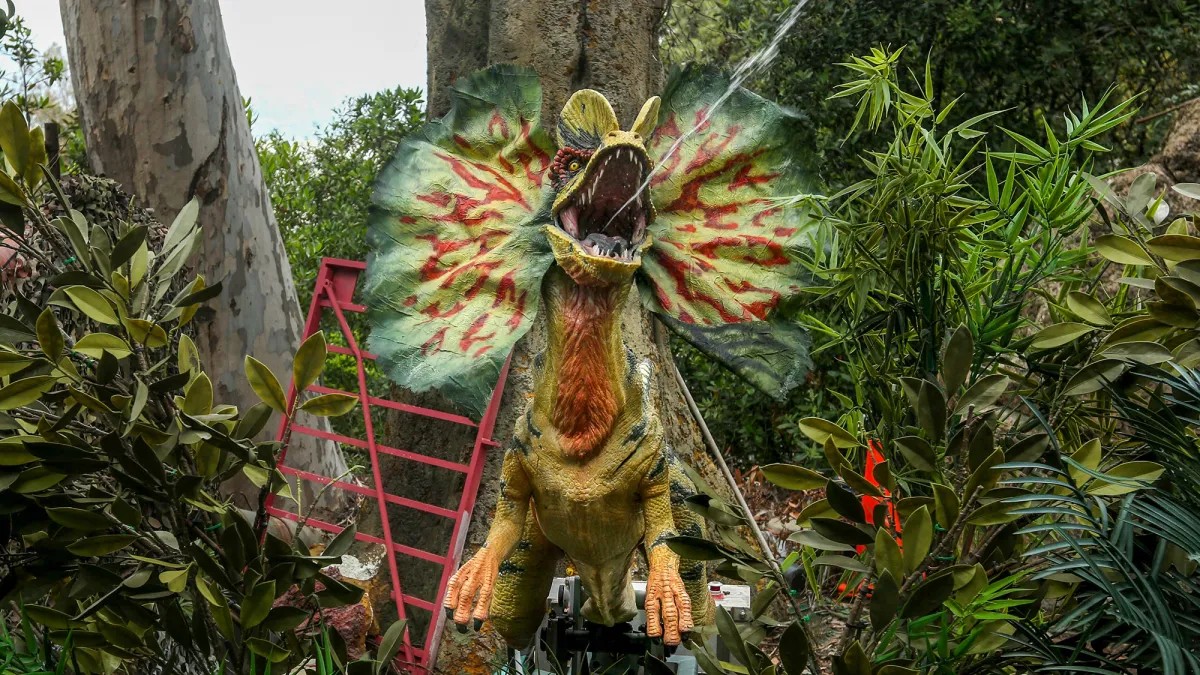
The question of venomous dinosaurs rose to prominence after the release of Jurassic Park in 1993, where the Dilophosaurus was depicted as a venom-spitting predator. Although the frill around its neck was pure artistic license, early paleontologists speculated that Dilophosaurus might have had some form of toxic bite. Modern analysis has debunked this theory: the dinosaur’s jaws were stronger than originally believed, and the supposed venom gland was simply part of the jawbone.
However, venom itself isn’t new to the fossil record. The earliest confirmed venomous vertebrate was Euchambersia, a lizard-like creature from around 250 million years ago, predating dinosaurs by over 10 million years. This suggests that the evolutionary path to venom existed long before dinosaurs emerged.
The challenge with confirming venom in extinct dinosaurs lies in the fossilization process. Venom glands are soft tissues that rarely survive millions of years. Scientists must rely on indirect clues, such as grooves in teeth that might have guided venom delivery. Yet, even these indicators are unreliable; some modern venomous reptiles, like Komodo dragons, lack visible grooves.
One potential candidate for a venomous dinosaur was Sinornithosaurus, a small, feathered species from China. Researchers identified grooves in its teeth that resembled venom channels. Later research, however, cast doubt on this theory, suggesting the grooves could have served other functions.
While no definitive evidence supports venomous dinosaurs, some reptiles coexisting with them were venomous. Uatchitodon, a Triassic archosauromorph (a group including dinosaurs, crocodiles, and pterosaurs), possessed clear venom-delivery systems in its teeth. However, only its teeth have been found, leaving its exact classification uncertain.
The distinction between venomous and poisonous is also crucial: venom is injected (like a snake bite), while poison is toxic upon contact or ingestion (like poison dart frogs). There is the possibility that some dinosaurs may have been poisonous rather than venomous. Modern birds, descendants of dinosaurs, such as the pitohui of New Guinea, store toxins in their skin and feathers, obtained from insects they eat. If a dinosaur had a similar diet, it could theoretically have been poisonous, but detecting such traits in fossils is impossible.
The fossil record remains incomplete, and the absence of evidence isn’t proof of absence. Venom may have evolved and disappeared in dinosaur lineages, leaving no trace for paleontologists to discover. However, as of today, the idea of venomous dinosaurs remains largely speculative.