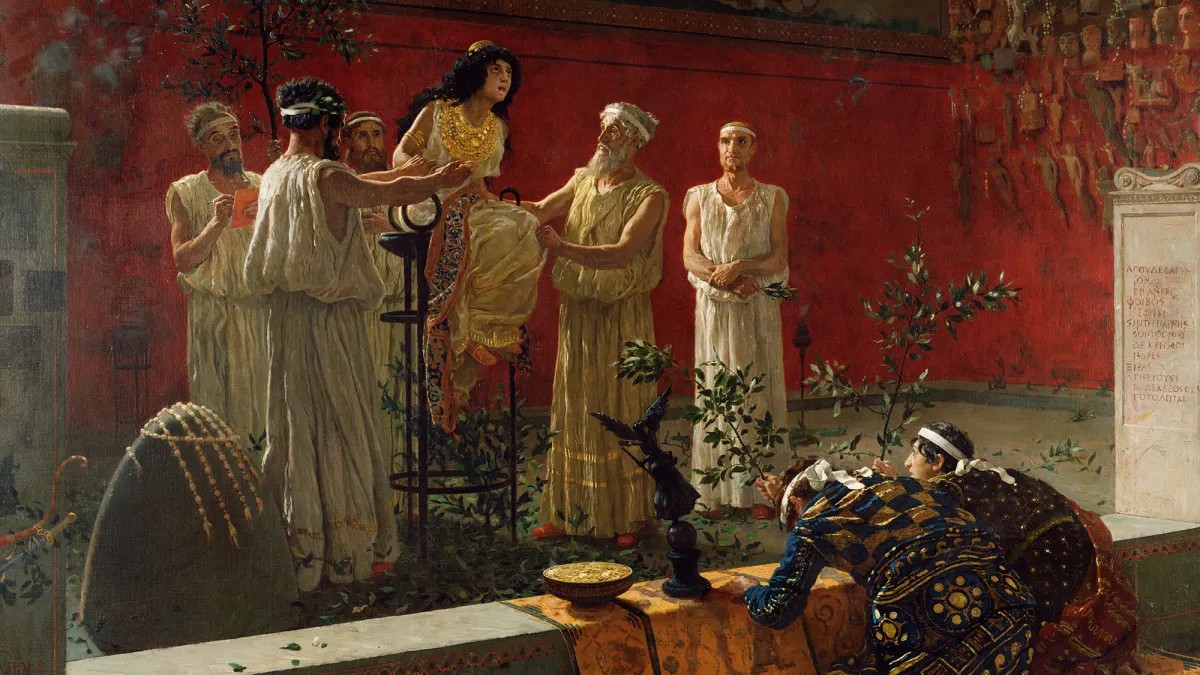
For centuries, the Oracle of Delphi in ancient Greece held sway over kings, commoners, and even Alexander the Great. People traveled for miles seeking prophecies delivered by the Pythia, a priestess who purportedly spoke with the voice of Apollo while in a trance. But the source of her visions wasn’t divine inspiration; it was likely the fumes from a naturally occurring geological phenomenon.
The Sweet-Smelling Pneuma
Ancient writers, including Plutarch, described the temple of Delphi as built around a spring releasing a sweet-smelling gas called pneuma. The Pythia would sit on a tripod stool, inhaling this gas to induce her ecstatic, prophetic state. Accounts detail how the priestess could cry out, become hysterical, or even collapse under the effects—an ordeal so exhausting that multiple women shared the role to avoid fatal strain.
For centuries, the mystery of the gas persisted. Was it real? And if so, what was it? Early scientific exploration dismissed the accounts, as no major fissures were found to explain such an emission. The assumption was that gases only rose from volcanic activity, and Delphi lacked a volcano.
Tectonic Plates and Hydrocarbon Gases
Modern archaeology, spurred by ancient texts, has uncovered the truth. Geologist Jelle Zeilinga de Boer noted a fault line beneath the temple in the 1980s. Fault lines are where tectonic plates grind against each other, creating friction and heat. This heat can transform solid hydrocarbons in the Earth’s crust into gases like methane, ethane, and ethylene.
Testing of the porous limestone bedrock at Delphi in 1996 confirmed the presence of these hydrocarbons. The gas rose through small channels in the stone, reaching the priestess’s lungs.
The Science of the Trance
Ethylene, a key component of the pneuma, is a widely produced organic compound used in ripening fruit and once even as a surgical anesthetic. Inhaling high concentrations induces unconsciousness. But lower, concentrated doses produce an altered state of mind: lucidity mixed with strange behavior, agitation, and memory loss.
Toxicologist Henry Spiller found striking parallels between ethylene intoxication and the Pythia’s described trance. The sweet smell, as Plutarch noted, matches ethylene perfectly. Prolonged inhalation carried health risks, explaining why the priestess’s tenure was often short-lived.
The Lasting Geological Reality
Today, we understand that tectonic activity can release gases even without volcanoes. The porous limestone at Delphi allowed hydrocarbons to seep upwards, accumulating in the temple chamber where the Pythia sat. Some gas still rises from groundwater today, occasionally lethal to birds.
Delphi stands apart from other oracles because of its explicit mention of the sweet-smelling gas. Other sites, like Hierapolis, used different gases (carbon dioxide) in religious rituals, but Delphi’s unique geology made it the only place where a gas-induced trance was openly part of the sacred experience.
The decline of the Oracle, as Plutarch observed, may have been due to clogging channels or seismic shifts altering gas pathways. But one thing remains clear: the Oracle of Delphi wasn’t a psychic; she was a geological phenomenon.