NASA has begun releasing the first high-resolution photographs captured during the Artemis II mission, a historic lunar flyby that has provided humanity with its most intimate view of the Moon and Earth in decades. The images, taken by astronauts Reid Wiseman, Victor Glover, Christina Koch, and Jeremy Hansen, offer a perspective of our celestial neighborhood that was previously impossible to achieve.
Capturing the Unseen: Eclipses and Earthsets
The mission provided several rare visual phenomena that have captivated both the crew and the scientific community:
- A Lunar Solar Eclipse: One of the most significant captures was a total solar eclipse viewed from just a few thousand miles above the lunar surface. This perspective offers a unique look at how light and shadow interact in the vacuum of space.
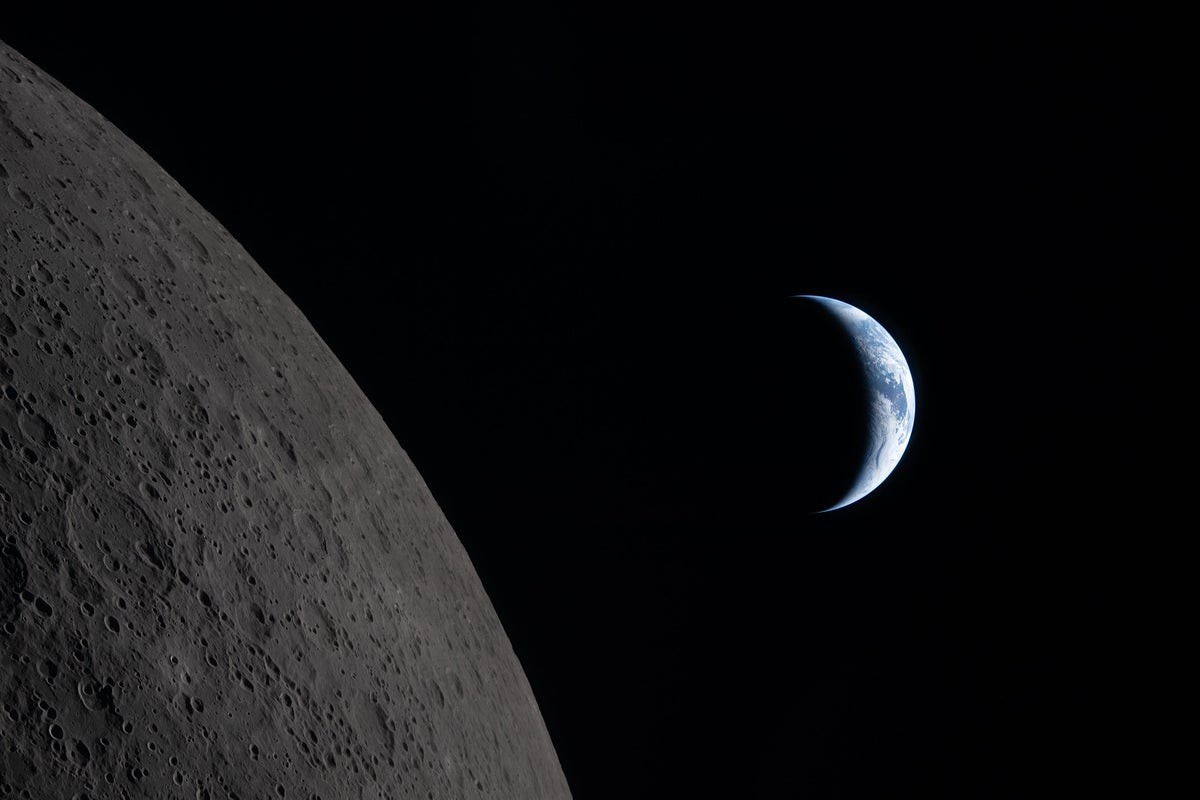
- “Earthset” and “Earthrise”: In a poetic nod to the legendary 1968 Apollo 8 “Earthrise” photograph, the crew captured the Earth as it dipped below the lunar horizon and rose again as a slender crescent.
- The Lunar Terminator: The astronauts highlighted the “terminator”—the dividing line between the Moon’s day and night sides. This lighting condition creates long, dramatic shadows that accentuate the Moon’s topography, making craters, hills, and valleys appear three-dimensional and strikingly vivid.
Scientific Focus: Mapping the Lunar Surface
While the visual beauty of the mission is undeniable, the flyby served a critical scientific purpose. Guided by science officer Kelsey Young, the crew utilized a detailed topographical guide to document specific lunar features.
A primary target was the Orientale Basin, a massive, multi-ringed impact crater. By capturing these features up close, the mission provides high-fidelity data that will be essential for future lunar landings and long-term human habitation.
“It’s just, it’s indescribable… It is absolutely spectacular, surreal,” remarked astronaut Reid Wiseman, noting that the visual experience defied standard language.
Why This Mission Matters
The Artemis II flyby is more than just a photographic opportunity; it is a vital test of human endurance and technology in deep space. By navigating the lunar environment and maintaining communication (save for a 40-minute period during lunar occultation), the crew has demonstrated the capability required for the next phase of NASA’s goals: establishing a sustainable human presence on and around the Moon.
The transition from “observing” the Moon from Earth to “experiencing” it from orbit marks a fundamental shift in our relationship with space exploration.
In summary, the Artemis II images represent a milestone in space photography and lunar science, providing unprecedented visual data that bridges the gap between distant observation and direct human exploration.