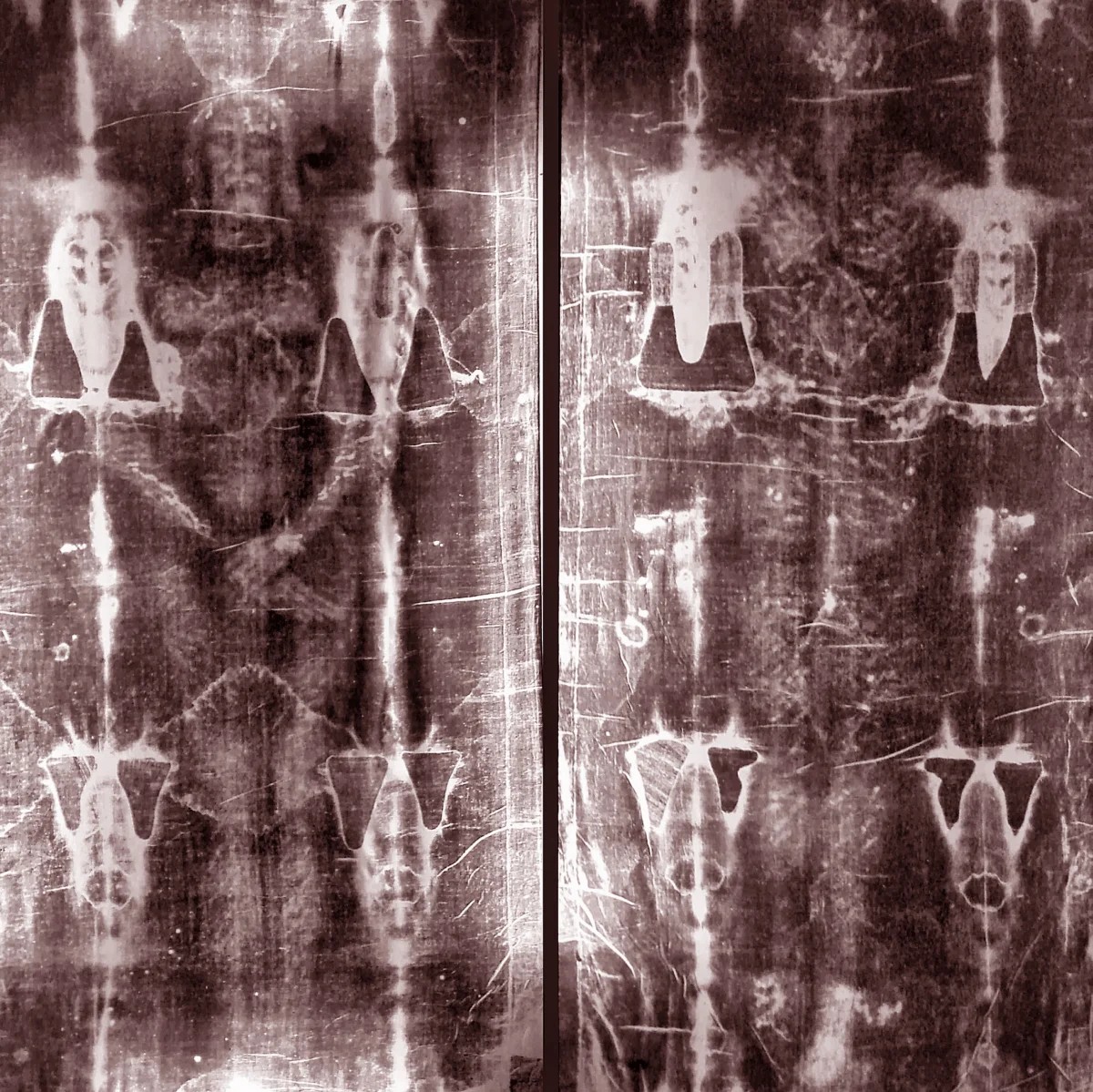
A recent study investigating the genetic traces found on the Shroud of Turin has reignited a centuries-old debate. New research suggests the cloth may have been woven with yarn from India and traveled extensively across the Mediterranean, potentially linking its origins to the Levant—the biblical setting of the New Testament.
However, while the findings offer a tantalizing glimpse into the relic’s history, many in the scientific community urge caution, noting that the results may be more a reflection of modern contamination than ancient origins.
The Study: A “Metagenomic” Deep Dive
Researchers Gianni Barcaccia (University of Padua) and Alessandro Achilli (University of Pavia) utilized a technique known as metagenomics to analyze a fragment of the shroud collected in 1978. Instead of looking for a single source, they sequenced all genetic fragments found in the sample to identify human, animal, plant, and microbial DNA.
The study reported a “cornucopia” of genetic material, including:
– Human DNA: Matching the original 1978 collector and various groups from Western Eurasia, Europe, and the Near East.
– Animal DNA: Traces from cats, dogs, cattle, and pigs.
– Plant DNA: Evidence of carrots, wheat, corn, peanuts, and bananas.
The researchers suggest these findings point to a history of extensive exposure in the Mediterranean region and imply that the textile’s raw materials may have originated in the Indian subcontinent.
The Skepticism: Contamination vs. History
Despite the provocative conclusions, experts warn that the presence of diverse DNA does not necessarily prove where the cloth began its journey. The central challenge with the Shroud is its extreme level of contamination.
“Since the object has been touched by people coming from even distant places… it has been contaminated in various ways, without any possibility of reconstructing all the stages and the point of origin.”
— Andrea Nicolotti, Historian at the University of Turin
Several factors complicate the interpretation of this new data:
1. The “Banana” Problem
Critics point out that finding banana DNA does not prove the shroud was in a tropical region; it simply proves the shroud came into contact with something containing banana DNA. Given that the shroud has been displayed in France, Switzerland, Belgium, and Italy, it has been exposed to centuries of dust, skin cells, and environmental debris.
2. Methodological Weaknesses
Biological anthropologists, such as Allison Mann of the University of Wyoming, note that the methods used to match plant and animal DNA are prone to false positives. Christina Warner of Harvard University echoed this, suggesting that many of the identified species might be “data artifacts”—errors in the digital processing rather than actual biological traces.
3. The Technological Timeline
Historian Andrea Nicolotti highlights a significant archaeological hurdle: the weaving style of the shroud. The cloth appears to have been made on a four-shaft horizontal treadle loom. Historical records suggest this specific technology was not widely available in the Mediterranean during the time of Jesus, but rather emerged later via the Flemish in the 13th century.
The Scientific Deadlock
The Shroud of Turin remains one of the most polarizing artifacts in history. In 1989, radiocarbon dating by three independent labs concluded with 95% certainty that the cloth dated to between 1260 and 1390, long after the era of Christ. While believers often contest these findings, any definitive proof to the contrary would require new radiocarbon testing—a process that involves destroying parts of the cloth, which the Vatican is unlikely to permit.
Conclusion: While the new metagenomic data provides a fascinating map of the biological “noise” on the Shroud, it falls short of proving its biblical origins. Until these findings are peer-reviewed and the potential for modern contamination is strictly ruled out, the shroud remains a mystery caught between scientific scrutiny and religious devotion.