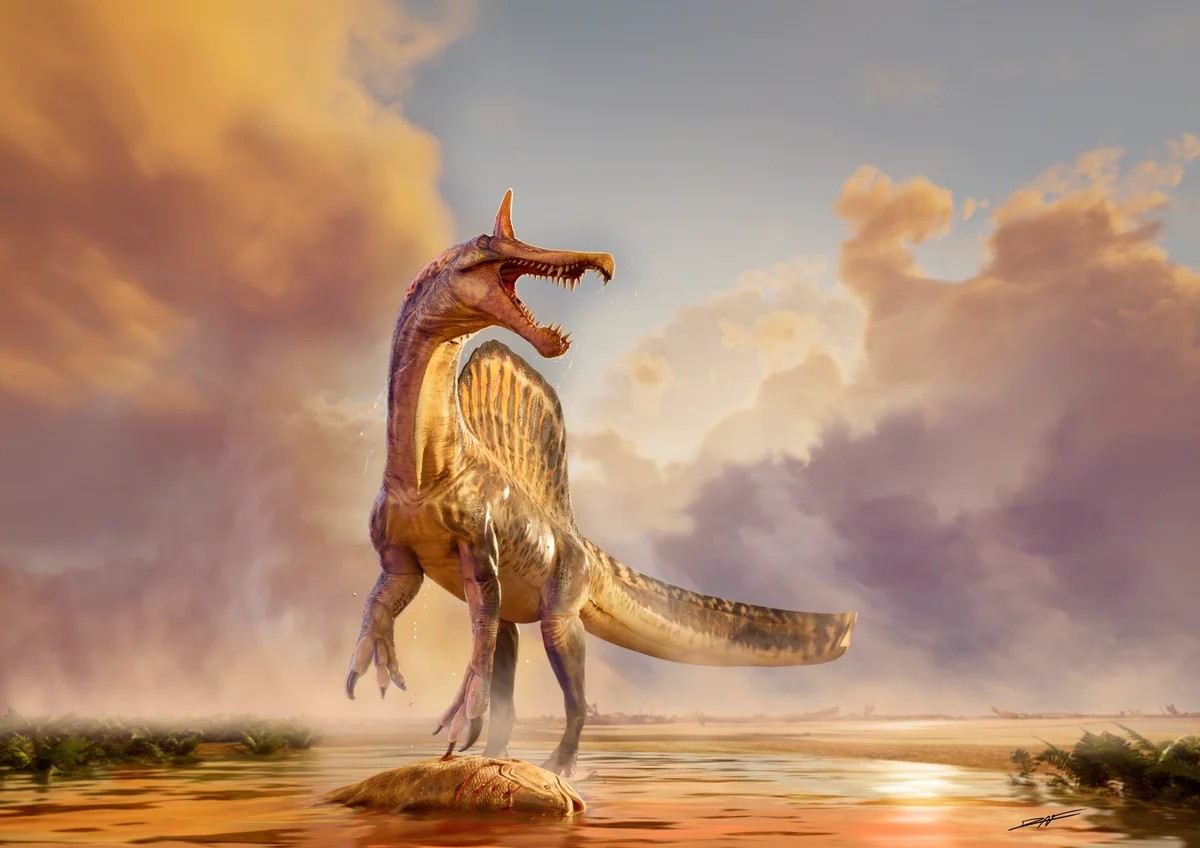
Millions of years ago, before the Sahara Desert existed, a thriving ecosystem bordered the ancient Tethys Sea. This region, once part of the supercontinent Pangaea, was home to colossal dinosaurs, including a newly discovered species of predatory dinosaur that stalked both land and water. Spinosaurus mirabilis, as it has been named, stood between 10 and 14 meters tall and was crowned with a massive, blade-like crest.
The discovery, published in Science, occurred almost by accident. The fossil site was known, but inaccessible; no researcher had visited in decades until paleontologist Paul Sereno and his team from the University of Chicago arrived in 2019. Guided by a local, they unearthed a trove of fossils, including the remains of S. mirabilis.
The Significance of Inland Discovery
The new species’ remains were found far inland, challenging the prior assumption that Spinosaurids were exclusively aquatic hunters. Daniel Vidal, co-author and paleontologist at the University of Chicago, emphasizes that the bones “were the jaws of a carnivorous dinosaur”.
The dinosaur likely hunted in shallow waters, resembling a larger, more aggressive heron, ambushing prey in both terrestrial and aquatic environments. This hunting behavior is supported by anatomical features: interlocking conical teeth and long legs suitable for wading.
A Unique Crest
The most striking characteristic of S. mirabilis is its enormous crest – measuring 50 centimeters – which initially baffled researchers. The crest, covered in keratin and potentially brightly colored, likely served multiple functions, including attracting mates and intimidating rivals. Roger Benson, a paleobiology curator at the American Museum of Natural History, notes that this crest is “striking” and “conspicuous” compared to other Spinosaurids.
Paleontological Advancements
Modern technology played a crucial role in the discovery. The team used three-dimensional modeling on-site, allowing for real-time reconstruction of the dinosaur before excavation was complete. This approach represents a leap forward in paleontology, enabling quicker analysis and deeper understanding of ancient species.
The discovery of Spinosaurus mirabilis reinforces the idea that Spinosaurids were adaptable predators, capable of thriving in diverse environments. The evidence suggests that the species was not limited to aquatic hunting, as some earlier theories proposed.
The expedition led by Sereno may well be remembered as a landmark event in paleontological history, as it has rewritten our understanding of ancient dinosaur behavior and evolution.