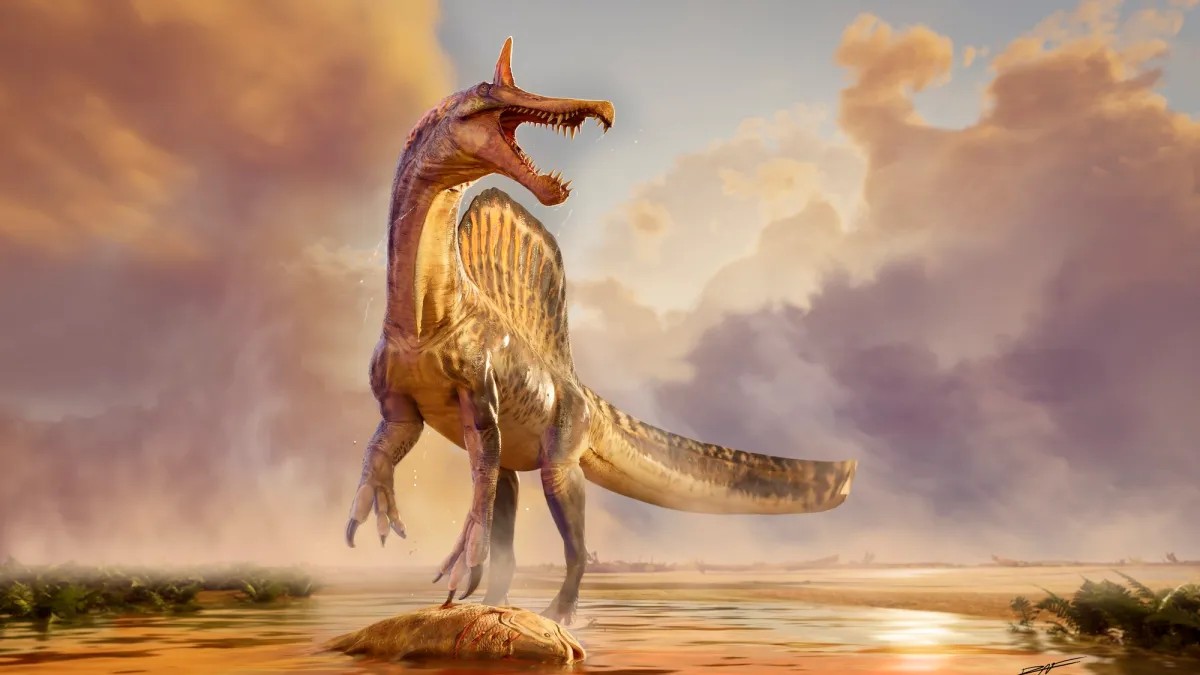
Paleontologists have unearthed a remarkable new dinosaur species in the heart of the Sahara Desert, challenging existing theories about the lifestyle of Spinosaurids – a group known for their fin-backed, crocodile-like features. The discovery, detailed in the journal Science, introduces Spinosaurus mirabilis, a horned predator that thrived in central Africa roughly 95 million years ago.
A Unique Predator
S. mirabilis is distinguished by its striking head crest, a curved, sword-shaped structure measuring 20 inches long. This feature, likely brightly colored and keratin-based, adds to the dinosaur’s already imposing presence. However, what truly sets this species apart is where it was found: deep inland, hundreds of miles from ancient coastlines.
Inland Hunting Grounds
Previous Spinosaurid fossils have always been discovered near prehistoric shorelines, leading scientists to believe they were primarily aquatic hunters. This new find overturns that assumption. The S. mirabilis bones were located in a forested region intersected by waterways, suggesting it stalked prey in both rivers and shallower traps.
“I envision this dinosaur as a kind of ‘hell heron’ that had no problem wading on its sturdy legs into two meters of water, but probably spent most of its time stalking shallower traps for the many large fish of the day,” said paleontologist Paul Serano, co-author of the study.
A Specialized Hunter
Beyond its inland habitat, S. mirabilis possesses a unique dental arrangement: its lower jaw teeth protrude between the upper set, creating a “fish trap” mouth. This adaptation, previously only observed in pterosaurs, ichthyosaurs, and crocodilians, confirms S. mirabilis was a specialized piscivore – a predator adapted to ambush aquatic prey.
This discovery finally puts to rest the theory that Spinosaurus primarily lived and hunted in marine environments.
Unanswered Questions
While S. mirabilis provides vital insights into Spinosaurid evolution, it also raises further questions about their behavior, habitat, and role in the Cretaceous ecosystem. The sudden discovery has left researchers eager to uncover more secrets about this ancient predator.
The discovery of Spinosaurus mirabilis highlights how much remains unknown about the age of dinosaurs and the unexpected ways in which species adapted to their environments. The find serves as a reminder that even well-studied groups like Spinosaurids still hold surprises, buried beneath the sands of time.