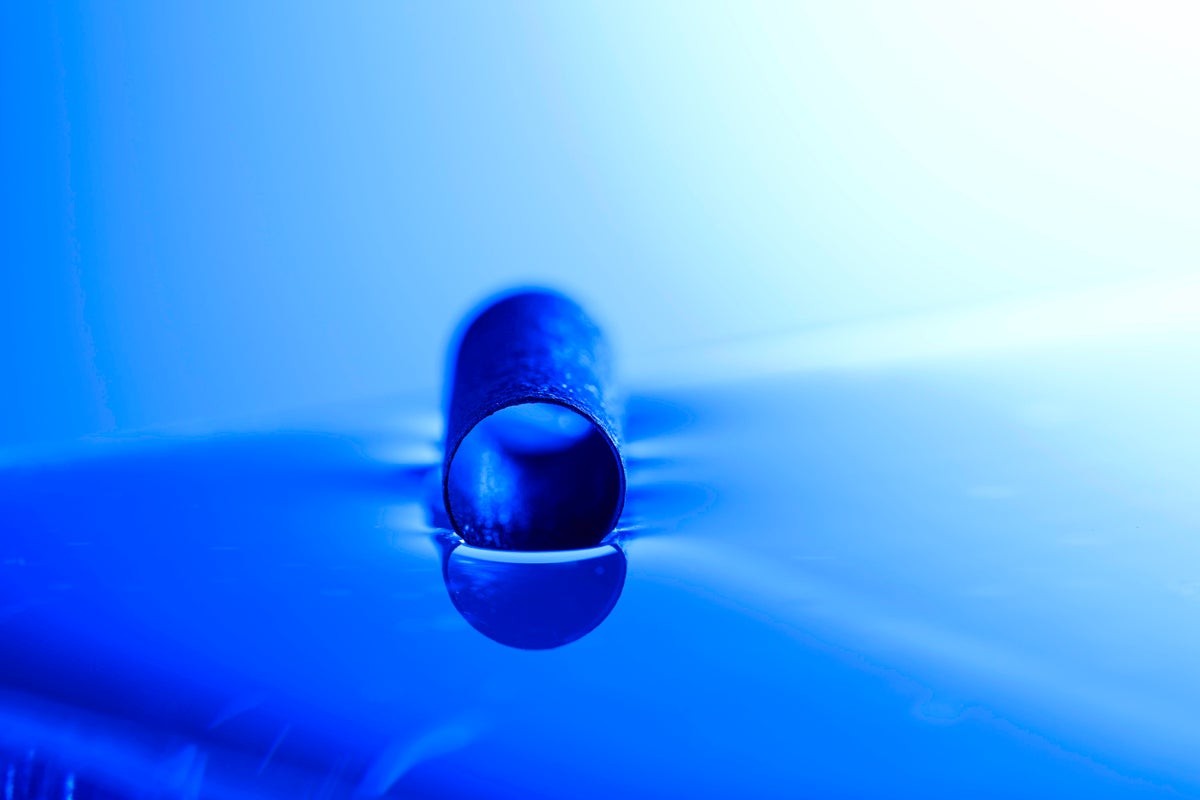
For centuries, the principle has been immutable: metal sinks. Drop a coin in water, and gravity dictates the result. But recent breakthroughs at the University of Rochester have upended this certainty, revealing a method to create metal structures that defy sinking – even when severely damaged. This isn’t just a scientific curiosity; it has implications for maritime safety, sustainable energy, and the fundamental understanding of material science.
Mimicking Nature’s Ingenuity
The research, published in Advanced Functional Materials on January 27, 2026, hinges on superhydrophobicity – an extreme water-repelling property. The team, led by Professor Chunlei Guo, utilized lasers to etch microscopic ridges into aluminum tubes, creating a texture akin to corduroy fabric at the nanoscale. This structure traps air, preventing water from penetrating and ensuring buoyancy.
“You can poke big holes in them,” Guo stated. “We showed that even if you severely damage the tubes…they still float.”
This technique draws inspiration from the natural world. Diving bell spiders, for instance, carry an air bubble underwater by trapping it in fine hairs covering their bodies. Fire ants use similar principles, forming buoyant rafts during floods that can survive for over twelve days. The metal tubes mimic this behavior, retaining air even under turbulent conditions thanks to an internal divider that prevents escape.
Beyond the Lab: Real-World Applications
Previous attempts at creating buoyant metal, such as embedding hollow spheres in magnesium alloys (NYU, 2015) or laser-etching disks (Guo’s lab, 2019), faced limitations. The disks were unstable in rough water, allowing air to escape. The new tube design overcomes this issue, maintaining buoyancy even under stress.
The implications are significant. The most immediate application lies in maritime engineering. Imagine ships built with these materials remaining afloat even with hull breaches – a game-changer for safety. But the potential extends further.
- Wave energy harvesting: The tubes could form rafts capable of generating electricity from wave motion.
- Weight-bearing structures: Linked tubes could create buoyant platforms for various purposes.
The current prototypes are roughly half a meter long, but Guo’s team has already increased laser power sevenfold since their initial experiments, indicating scalability is not a barrier.
Why This Matters
This discovery isn’t just about floating metal. It highlights the power of biomimicry – learning from nature’s solutions. The superhydrophobic effect has long been known, but applying it to a structurally sound, scalable material opens entirely new possibilities. The fact that this was achieved through laser etching makes it relatively accessible compared to previous methods.
The research also raises questions about how we traditionally view material properties. If density isn’t the sole determinant of buoyancy, what other fundamental assumptions can be challenged? This work suggests that manipulating surface textures and air retention could redefine our understanding of material behavior, leading to further innovations beyond maritime and energy applications.
In conclusion, the development of unsinkable metal represents a paradigm shift in material science. By learning from the natural world and refining existing techniques, researchers have unlocked a potential that could reshape industries and redefine the limits of engineering.