The universe’s most powerful supernovae are now understood to be powered by the birth of rapidly spinning, highly magnetized neutron stars called magnetars. For years, astronomers have puzzled over superluminous supernovae – explosions that outshine ordinary supernovae by a factor of ten or more, and persist for far longer. New research published in Nature confirms that these extraordinary events are driven by the immense energy released from a newborn magnetar. This discovery not only solves a long-standing mystery but also marks the first confirmed observation of a magnetar forming in real-time.
The Mystery of Superluminous Supernovae
Superluminous supernovae have baffled scientists since their initial detection in the early 2000s. Their exceptional brightness and extended duration challenged existing models of stellar death. When a massive star collapses, it typically explodes, leaving behind either a neutron star or a black hole. Neutron stars are incredibly dense – a teaspoonful weighs billions of tons – and can be sites of extreme physics. Some neutron stars spin rapidly, emitting beams of radiation as pulsars. Magnetars, however, are the most extreme: newborn pulsars with magnetic fields a thousand times stronger than typical neutron stars.
The Breakthrough: SN 2024afav and Lense-Thirring Precession
The key to unlocking this mystery came with the observation of SN 2024afav, a superluminous supernova located roughly a billion light-years from Earth. Astronomers tracked the supernova for 200 days, noting a peculiar pattern: its brightness periodically dipped, with the intervals between dips shrinking over time. This behavior didn’t align with any known energy source except one: a rapidly spinning magnetar.
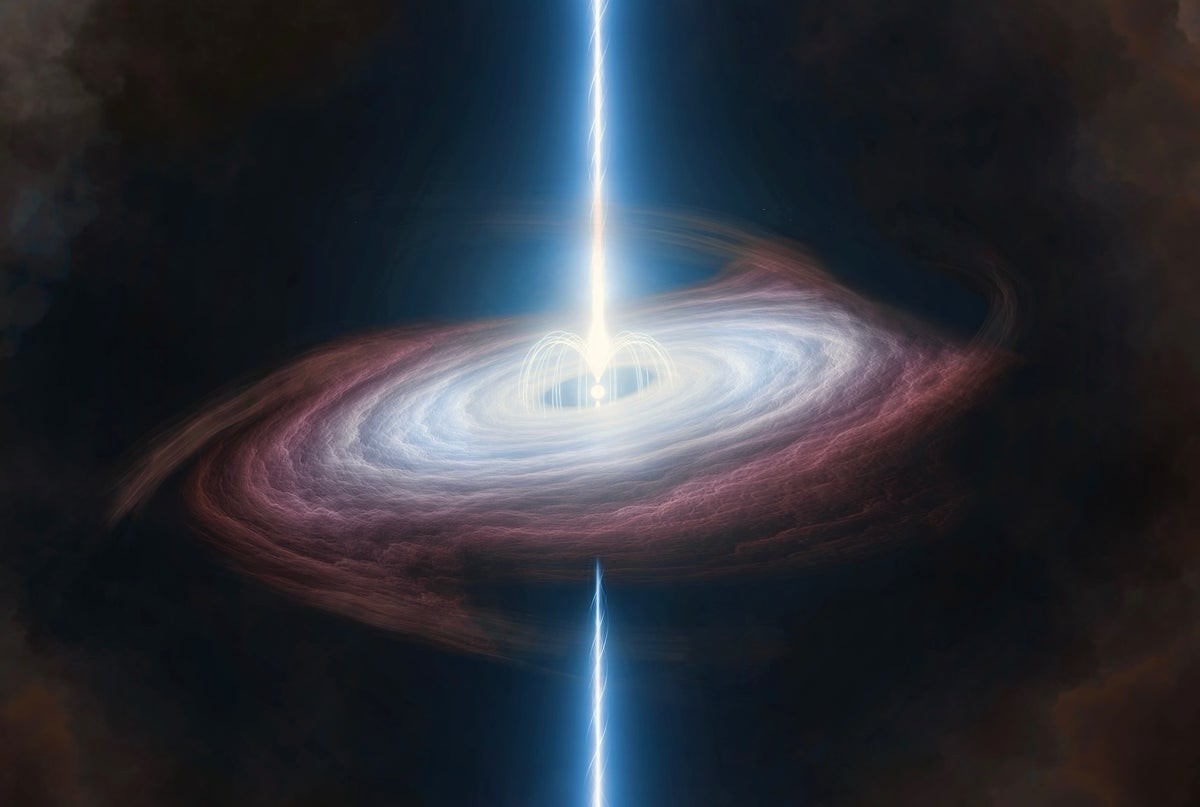
The magnetar’s immense magnetic field twists and contorts as it spins at near-light speed, pumping out tremendous radiation. This energy supercharges the surrounding ejected gas, amplifying the supernova’s luminosity and extending its lifespan. Crucially, the observed dips in brightness were explained by a phenomenon predicted by Einstein’s general relativity: Lense-Thirring precession. The magnetar’s extreme gravity warped spacetime, causing a surrounding disk of matter to wobble like a spinning top. From Earth’s perspective, this wobbling disk periodically blocked our view of the magnetar, creating the observed flickering pattern.
Why This Matters
This discovery is significant for several reasons. First, it provides conclusive evidence for the magnetar-powered engine behind superluminous supernovae. Second, it confirms a long-standing theoretical prediction. Third, it offers a unique opportunity to test general relativity in extreme gravitational conditions. The environment around a magnetar is so intense that even subtle predictions of the theory become measurable effects. As Adam Ingram, an astrophysicist at Newcastle University, notes, “Everything about the system is extreme…the gravitational field is strong enough for the most exotic predictions of general relativity to be large effects.”
The confirmation of magnetars as the driving force behind these events opens new avenues for research into stellar evolution, extreme physics, and the fundamental laws governing the universe. The discovery marks a major step forward in understanding the most violent and energetic phenomena in the cosmos.