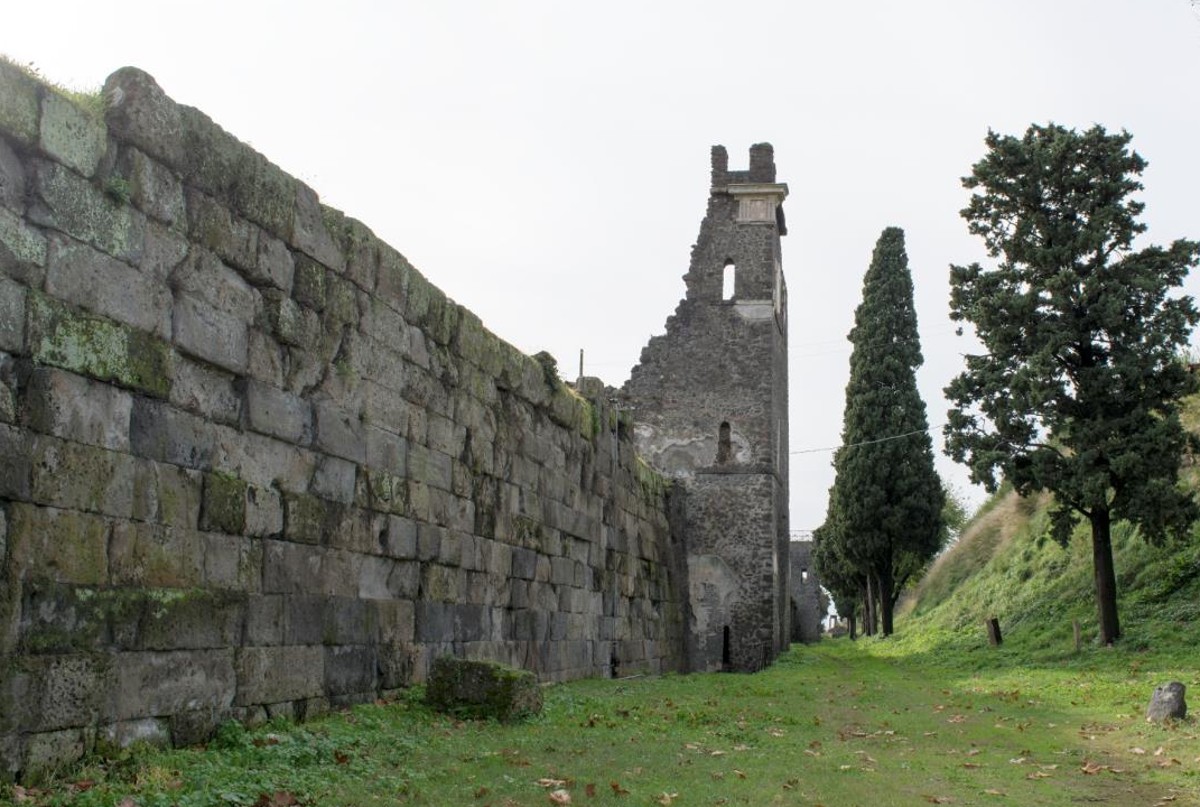
Recent archaeological findings in Pompeii have uncovered striking damage on the city’s northern fortification walls, offering a rare glimpse into the brutal warfare of the late Roman Republic. Researchers believe these marks may be the first physical evidence of a legendary ancient repeating weapon: the polybolos.
The Siege of 89 B.C.E.
The damage dates back to a pivotal moment in Pompeii’s history. In 89 B.C.E., the city was besieged by an army of tens of thousands led by the Roman commander Lucius Cornelius Sulla. While Pompeii is most famous for its destruction by Mount Vesuvius in 79 C.E., this earlier conflict was a violent struggle for control that ultimately brought the rebellious city back under the authority of the Roman Republic.
The marks were discovered during excavations and surveys conducted since 2024. Located between defensive towers used by archers and scouts, these clusters of gouges were perfectly preserved by the volcanic ash of Vesuvius nearly a century after the siege took place.
The Mystery of the Polybolos
For centuries, the polybolos existed only in historical texts. It was described in the 3rd century B.C.E. by the Greek engineer Philo of Byzantium, who detailed its mechanics but dismissed it as an impractical novelty.
What makes the polybolos unique among ancient artillery is its ability to fire repeatedly:
– Mechanism: Similar to a giant crossbow, it used a “torsion mechanism” (made of fiber or hair) to launch iron-tipped darts at high speeds.
– The “Chain” Effect: Unlike standard catapults, it featured a mechanism similar to a modern bicycle chain, allowing it to automatically reload darts.
– Firing Pattern: Historical descriptions suggest that when fired at a target, the weapon would leave a distinct, “fan-like” spray of impact marks.
Evidence in the Stone
To determine if these marks were caused by a standard catapult or a repeating weapon, researchers used 3D modeling and mathematical analysis. They found that the angles and grooves of the gouges did not align with the typical impact patterns of sling bullets or single-shot catapults. Instead, the arrangement closely resembles a concentrated “burst” of fire.
“It was an antipersonnel weapon used to strike archers emerging from the battlements above and the postern below,” explains Adriana Rossi, a lead author and engineer at the University of Campania Luigi Vanvitelli.
While some historians, such as Michael Taylor of the University at Albany, suggest the marks could simply be the result of a regular catapult being repositioned between shots, the “machine-gun” pattern remains a compelling possibility.
Why This Matters
If the hypothesis is correct, this discovery provides the first material evidence of a weapon that was previously thought to be purely theoretical. Furthermore, it highlights the tactical ingenuity of Roman commanders like Sulla, who were known for utilizing highly specialized and advanced military technology to achieve victory.
The discovery bridges the gap between ancient engineering theory and the reality of Roman battlefield technology, potentially rewriting our understanding of ancient siege warfare.