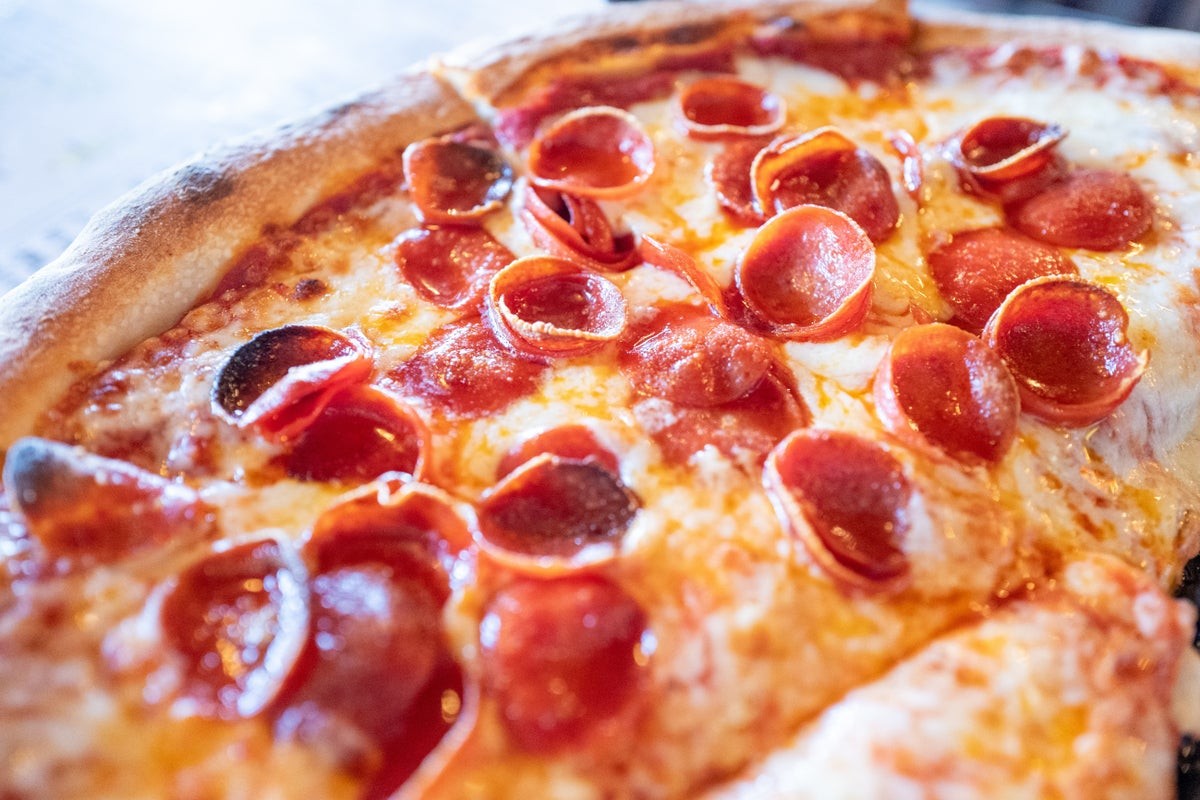
Sharing food can be a social minefield. While cutting a sandwich in half seems straightforward, dividing a pizza becomes a complex problem when the toppings are unevenly distributed. If one person receives a mountain of pepperoni while the other gets only cheese, the division is objectively unfair.
Fortunately, mathematicians have a foolproof way to ensure equality, regardless of how messy the toppings are.
The Problem of Uneven Toppings
Imagine a perfectly circular pizza. You make a single straight cut through the center, dividing the dough, sauce, and cheese into two equal halves. However, if the pepperoni slices are clustered on one side, you encounter a dilemma: one half might contain 70% of the toppings, while the other contains only 30%.
To find a fair split, you can rotate your cutting line around the center of the pizza.
- At the starting position: The left side has 30% of the pepperoni.
- After a 180-degree rotation: The situation reverses, and the left side now holds 70% of the pepperoni.
Because the amount of topping on one side changes continuously as you rotate the knife, there is no way to jump from 30% to 70% without passing through every percentage in between.
The Intermediate Value Theorem
This phenomenon is explained by a fundamental mathematical principle known as the Intermediate Value Theorem.
The theorem states that if a continuous function (one with no sudden breaks or jumps) moves from one value to another, it must hit every value in between at least once. A common real-world example is temperature: if it is 20°C at 8:00 AM and 30°C at 3:00 PM, there was a specific moment during the day when the temperature was exactly 25°C.
In the context of the pizza, as you rotate your knife, the proportion of toppings on the left side moves steadily from 30% to 70%. Therefore, there must be a specific angle where the proportion is exactly 50%. At that precise moment, the pizza is divided perfectly fair.
What About Irregular Shapes?
Real-world pizzas are rarely perfect circles. Handmade crusts are often lopsided and asymmetrical, which complicates the idea of a “center” to cut through.
However, the math still holds up. Even with an irregular shape, you can identify a center of mass to serve as your pivot point. By rotating a line through this center, you can still trigger the same reversal of topping proportions. As long as the rotation eventually brings you back to your starting position with the distribution reversed, the Intermediate Value Theorem guarantees that a perfectly fair cut exists.
Conclusion: Whether a pizza is a perfect circle or a handmade irregular shape, mathematics guarantees that a fair division of toppings is always possible through a single, strategically placed cut.