


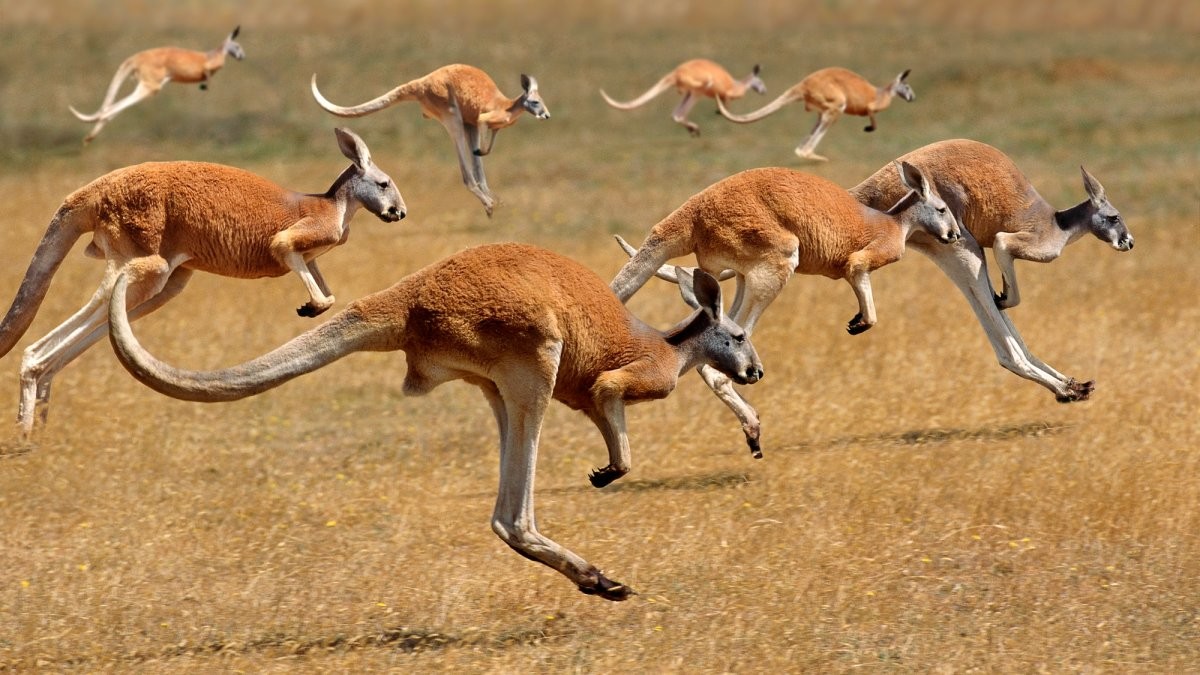
For millennia, the largest hopping animal on Earth has been the red kangaroo of Australia. But new research reveals that their Ice Age ancestors were far larger – and still capable of leaping across the landscape. Paleontologists have long debated whether kangaroos weighing over 550 pounds could physically hop, given the biomechanical limits of scaling up a modern kangaroo’s anatomy. Recent findings, however, suggest these ancient giants did hop, albeit differently than their modern relatives.
The Size of the Challenge
The largest of these extinct kangaroos, Procoptodon goliah, stood 6.5 feet tall and weighed over half a ton. Scaling up today’s kangaroos to such size implies hopping would be impossible due to the immense stress on bones and tendons. However, evolutionary scientist Megan Jones of the University of Manchester argues that comparing ancient and modern kangaroos directly is a flawed approach. “Previous estimates assumed they were just bigger versions of modern kangaroos, ignoring key anatomical differences,” she explains.
Anatomical Adaptations
The new study, published in Scientific Reports, compares modern kangaroo skeletons with Ice Age fossils. Researchers focused on foot bone strength and ankle support, finding that Sthenurinae kangaroos (the subfamily of giant kangaroos) possessed thicker, shorter foot bones and broader heels. This structure enabled them to handle the forces generated by hopping despite their size. Stronger tendons also played a critical role.
Hopping Style and Efficiency
The researchers emphasize that these giant kangaroos didn’t hop better than modern kangaroos; they hopped differently. Their thicker tendons, while safer for their massive frame, stored less elastic energy. This meant they were likely slower and less efficient at hopping long distances. Instead, they probably used hops for short bursts of movement: escaping predators, navigating rough terrain, or covering ground quickly when needed.
A Mixed Movement Repertoire
The fossil record suggests some giant kangaroos may have combined hopping with walking on two or four legs, adapting their movement to the situation. This flexibility allowed them to thrive in a range of environments. The discovery underscores how even the most massive animals can overcome apparent physical limitations through evolutionary adaptation.
The findings challenge long-held assumptions about megafauna mobility, demonstrating that size doesn’t necessarily equate to immobility. The ability of these giants to hop reveals a more dynamic picture of prehistoric Australia’s ecosystems.


