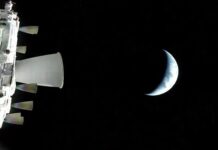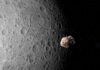
The Artemis II mission has officially crossed the two-thirds mark, marking a historic step toward returning humans to the vicinity of the Moon for the first time in over 50 years. As of Sunday morning, the Orion spacecraft was positioned more than 211,000 miles from Earth and roughly 68,500 miles from its lunar target.
This mission is not merely a flight; it is a high-stakes test of the systems and human endurance required for the next era of deep-space exploration.
A New Perspective on the Lunar Surface
As the crew—Commander Reid Wiseman, Pilot Victor Glover, and Mission Specialists Christina Koch and Jeremy Hansen—approaches the lunar flyby scheduled for Monday, April 6, they are seeing a side of the Moon that has remained hidden from Earth-based observers for millennia.
The mission is designed to bring the capsule within 4,000 miles of the lunar surface. At this proximity, the Moon will appear massive in the spacecraft’s windows, providing a unique vantage point for scientific observation.
- The Far Side Advantage: Mission specialist Christina Koch noted that the view of the Moon’s far side is “absolutely phenomenal” and looks nothing like the lunar landscape visible from Earth.
- Human Eyes vs. Satellites: While robots and satellites provide vast amounts of data, human astronauts offer a level of pattern recognition that machines often miss. This “human element” was famously demonstrated during the Apollo era when astronaut Harrison Schmitt identified volcanic evidence by spotting specific colored dust—a discovery that changed our understanding of lunar geology.
- Key Targets: The crew is currently tasked with observing specific geographic features, including the Orientale basin, a massive impact crater that holds significant scientific interest.
Technical Challenges and “Potty Talk”
Space travel is often romanticized, but the Artemis II mission is highlighting the gritty, practical realities of long-duration flight.
One of the most significant recent hurdles involved the spacecraft’s wastewater management. NASA engineers had to adjust the spacecraft’s orientation to point wastewater vent lines toward the sun, attempting to use solar heat to melt ice that was obstructing the drainage system.
This technical glitch forced the crew to temporarily abandon the spacecraft’s toilet in favor of “collapsible contingency urinals.” While the situation led to much humor and “potty talk” between the crew and Mission Control,, it underscores a vital reality: in deep space,, even the simplest biological functions require complex engineering to prevent system failures.
Preparing for the “Lunar Sphere of Influence”
As the mission enters Day Five, the Orion spacecraft is transitioning into the lunar sphere of influence —the point where the Moon’s gravity becomes the dominant force acting on the spacecraft, overriding Earth’s pull.
To prepare for this transition, the crew is focused on several critical tasks:
1. Manual Control Drills: Astronauts are taking turns steering the spacecraft. These tests are essential for future missions where the Orion capsule must perform precision docking maneuvers to transport crews to and from the lunar surface.
2. Survival System Checks: The crew is testing their “International Orange” spacesuits. These are not just for comfort; they are life-support systems capable of providing six days of breathable air in the event of a cabin depressurization.
3. Trajectory Adjustments: NASA is monitoring whether a corrective maneuver is needed to ensure the spacecraft stays on its precise path for the April 6 flyby.
Why This Mission Matters
The Artemis II mission serves as the ultimate rehearsal. Every maneuver, every technical glitch, and every manual steering test provides the data necessary to ensure that when NASA eventually sends humans to land on the Moon, the systems will be fail-safe.
As Pilot Victor Glover noted, the success of this mission proves a fundamental truth about modern spaceflight: “That we can do this right now means we could do so much more.”
Conclusion:
By successfully navigating the journey toward the Moon’s gravity and managing the complexities of deep-space life support, Artemis II is bridging the gap between Earth-orbit operations and true lunar exploration. The upcoming flyby will serve as a definitive test of human capability in the lunar environment.