


The global race for critical minerals is hitting a physical wall. As the world shifts toward renewable energy and electric vehicles, the demand for copper, gold, and silver is skyrocketing. However, the easiest-to-reach deposits are gone, leaving mining companies to face a daunting reality: they must dig deeper, extract lower-grade ore, and manage increasingly volatile underground environments.
To solve this, a surprising new ally has emerged from the heavens: cosmic rays.
The Growing Mineral Gap
The math behind the green energy transition is sobering. To meet “Net Zero 2050” goals, the International Energy Agency estimates that the production of critical minerals must increase sixfold. Meanwhile, supply shortages are worsening; J.P. Morgan predicts a refined-copper shortfall of 330,000 tons this year, a gap that could balloon to eight million tons by 2035.
Mining companies are caught in a squeeze:
– Declining Ore Grades: Miners must now process significantly more waste rock to extract the same amount of usable metal.
– Stagnant Discovery: Finding new “greenfield” sites is incredibly difficult and slow; in the U.S., it takes an average of 29 years to move from discovery to production.
– Environmental Impact: Massive open-pit mines, like the Kennecott Mine in Utah, leave enormous scars on the landscape.
The Shift to “Block Caving”
Because discovering new sites takes decades, many companies are turning to “brownfield” sites—existing mines—and expanding them vertically through a method called block caving.
Think of block caving as reverse open-pit mining. Engineers create a massive underground cavern, remove the support beneath an ore body, and let gravity do the heavy lifting. The rock collapses under its own weight, fracturing into rubble that funnels into “drawbells” for collection. While this method is cost-effective and keeps much of the environmental disturbance underground, it is inherently chaotic. It involves hundreds of millions of cubic meters of earth in constant, unpredictable motion.
Muon Tomography: An X-Ray for the Earth
The primary danger of block caving is uncertainty. If a cave collapses unevenly, it can create lethal air blasts or sudden mudslides. Currently, miners often operate “blind,” relying on scattered boreholes to guess where the rock is moving.
This is where muon tomography changes the game.
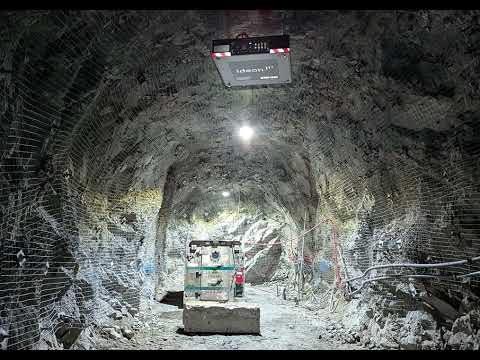
Muons are subatomic particles created when cosmic rays from supernovas strike Earth’s atmosphere. They rain down constantly, capable of penetrating up to 1.5 kilometers into the ground. By placing specialized detectors underground, companies can track these particles to create high-resolution, 3D maps of the surrounding density.
“It’s like an X-ray machine,” explains Gary Agnew, CEO of Ideon Technologies. “But instead of imaging a human body, we are assessing hundreds of millions of cubic meters of earth at a time.”
Why Muons Outperform Traditional Methods
Unlike older geophysical techniques, muon technology offers several distinct advantages:
– High Resolution: It can map structures at a sub-meter scale, whereas seismic sensing often struggles to resolve anything smaller than 50 meters.
– Operational Immunity: Traditional sensors are often disrupted by the noise and vibrations of a working mine. Muons, however, are unaffected by the mechanical chaos of extraction.
– Real-Time Data: New platforms can integrate muon density maps with seismic and magnetic data, providing a dynamic, constantly updating model of the mine.
Safety and the Cost of Failure
The stakes for this technology are life and death. In September 2023, a mudslide at the Grasberg mine in Indonesia killed seven workers due to an uneven cave collapse—a disaster that muon technology is specifically designed to prevent by identifying “air gaps” and unstable rock formations before they fail.
Beyond safety, the economic benefits are massive. Rio Tinto has already begun partnering with Ideon to deploy these sensors at several major operations. At the Kennecott Mine, the technology is being used to map “artisanal” voids left by a century of old mining, preventing modern equipment from accidentally falling into forgotten holes.
Conclusion
As the demand for minerals reaches unprecedented heights, the mining industry is undergoing a digital transformation similar to the oil and gas sector’s evolution in the 1990s. By using subatomic particles to see through solid rock, mining companies can move from guesswork to precision, making deep-earth extraction safer, more efficient, and more predictable.


