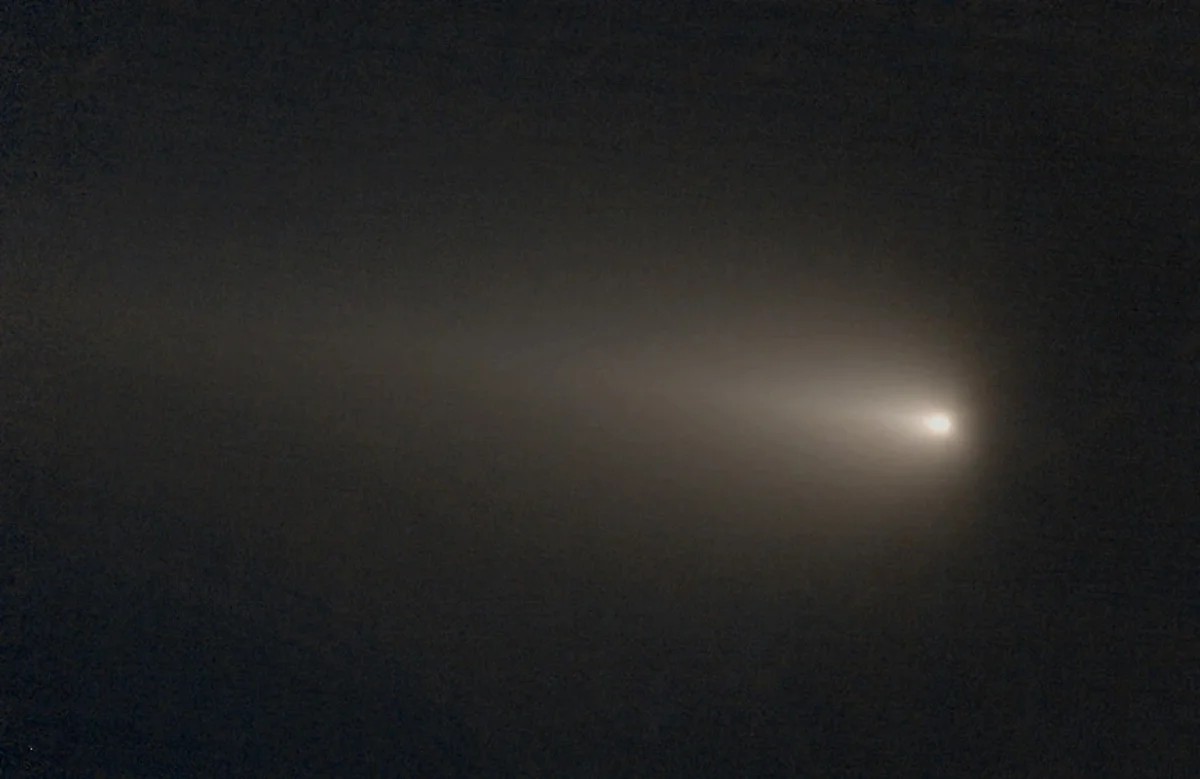
NASA’s Artemis II crew may witness an extraordinary cosmic event during their lunar flyby: a comet making an extremely close approach to the Sun. Discovered in January by amateur astronomers, Comet C/2026 A1 (MAPS) is now racing towards a potentially destructive encounter with our star on April 4th. The astronauts, the first humans to see the Moon’s far side up close in decades, could have a front-row seat to the comet’s fate.
The Hostile Environment of the Sun
The comet will pass within 101,100 miles (162,700 kilometers) of the Sun—a distance 40 times closer than NASA’s Parker Solar Probe has ever ventured. This extreme proximity subjects the comet to intense heat and radiation. Most comets that approach this closely disintegrate entirely, vaporizing into dust and gas. Whether MAPS survives is highly uncertain. According to Karl Battams, a space scientist at the Naval Research Laboratory, the comet will experience “the most hostile environment our solar system has to offer, and it will suffer accordingly.”
A Crowdsourced Science Initiative
The study of such “sungrazers”—comets that come within 850,000 miles of the Sun—is driven in part by the Sungrazer Project, a NASA-funded initiative that relies on data from both professional and amateur telescopes. The project has identified over 5,000 such comets to date. MAPS was discovered by Alain Maury, Georges Attard, Daniel Parrott, and Florian Signoret, using a remotely operated telescope in Chile. This discovery highlights the value of citizen science in astronomical observation.
Size and Activity: A Race Against Time
Comet MAPS is estimated to have an icy core roughly 1,300 feet (400 meters) across, based on recent observations from the James Webb Space Telescope. However, its size is shrinking as the Sun’s heat causes it to eject gas and dust. Quanzhi Ye, a planetary astronomer at the University of Maryland and Boston University, notes that the comet is already showing increased activity, raising the likelihood of fragmentation before its closest approach.
A Likely Disintegration
The consensus among scientists is grim: Comet MAPS is expected to break apart within days. Battams predicts, “My best guess is that it will disintegrate rapidly…leaving nothing but a faint cloud of dust.” Monitoring the comet is challenging due to its proximity to the Sun, making direct observation dangerous for human eyes and difficult even for specialized spacecraft.
In conclusion, the Artemis II astronauts may witness a spectacular, albeit destructive, cosmic event. Comet MAPS is on a collision course with the Sun, and its survival is improbable. The encounter serves as a stark reminder of the extreme forces at play in our solar system and the fragility of icy bodies venturing too close to our star.