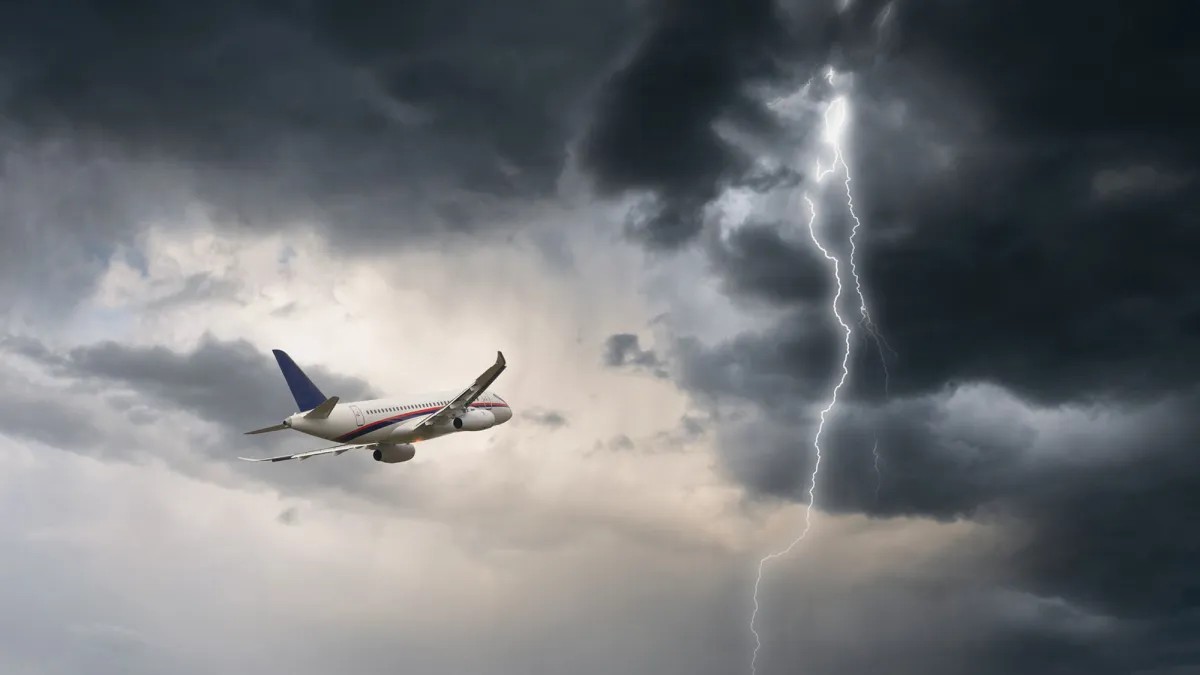
Commercial pilots rarely fly directly into thunderstorms, not because it’s necessarily catastrophic, but because it’s avoidable. Modern aviation relies on a layered system of monitoring, communication, and avoidance techniques to keep flights smooth and safe. The 2023 film Plane depicts a dramatic in-storm scenario, but the reality is far more controlled.
Tracking and Avoiding Storms in Real-Time
Pilots don’t just rely on pre-flight forecasts; they use real-time data. Before every flight, meteorologists provide detailed satellite mapping, but conditions change rapidly. To compensate, pilots constantly monitor onboard radar and the Weather Avoidance System (WAS). This equipment identifies storm locations, altitudes, movement speeds, and intensity.
Pilots also share information with each other via air traffic control. If turbulence is encountered, pilots broadcast warnings to other aircraft in the area. This collective awareness allows crews to request altitude or route changes to bypass storms—typically maintaining at least 10 to 20 miles of distance from severe weather. Radar displays color-code intensity, with green indicating mild turbulence, yellow suggesting severity, and red signaling conditions to avoid at all costs.
The Risks of Flying Through Storms
While intentional penetration is rare, pilots sometimes navigate between storm cells. This requires precise timing because weather can shift quickly. Flying over storms is also risky, as updrafts can extend to flight levels (40,000-50,000 feet), making clearance unpredictable.
The most significant damage from thunderstorms is often minor: hail can dent wings without compromising safety, though repairs cost money. More serious hail can crack windshields, but the aircraft remains controllable. Turbulence is uncomfortable but rarely catastrophic; pilots engage autopilot at Turbulence Penetration Speed to minimize stress on the plane.
Landing in Storms: The Greatest Risk
The most dangerous situation is turbulence near the ground during landing. Windshear—sudden shifts in wind speed or direction—poses the greatest threat. Modern aircraft have windshear detection systems, and airports have alerting systems. If detected, flights may enter holding patterns or divert to alternate airports. The decision rests with the captain, but is typically a collaboration between the pilots and dispatchers.
Lightning Strikes: Not as Scary as They Seem
Lightning strikes are surprisingly common—some aircraft are hit twice a year on average. Commercial planes are designed to withstand these shocks, with backup systems that engage if primary systems fail. The electricity flows around the fuselage, just like with a car, leaving passengers unharmed.
In practice, the biggest danger in thunderstorms isn’t catastrophic failure, but inconvenience. Avoiding storms is a calculated process that prioritizes safety while minimizing disruption to flight schedules.
Avoiding severe weather is not about luck; it’s about layered systems, constant monitoring, and coordinated decision-making. While movies may dramatize in-storm scenarios, real-world aviation prioritizes staying clear of trouble in the first place.