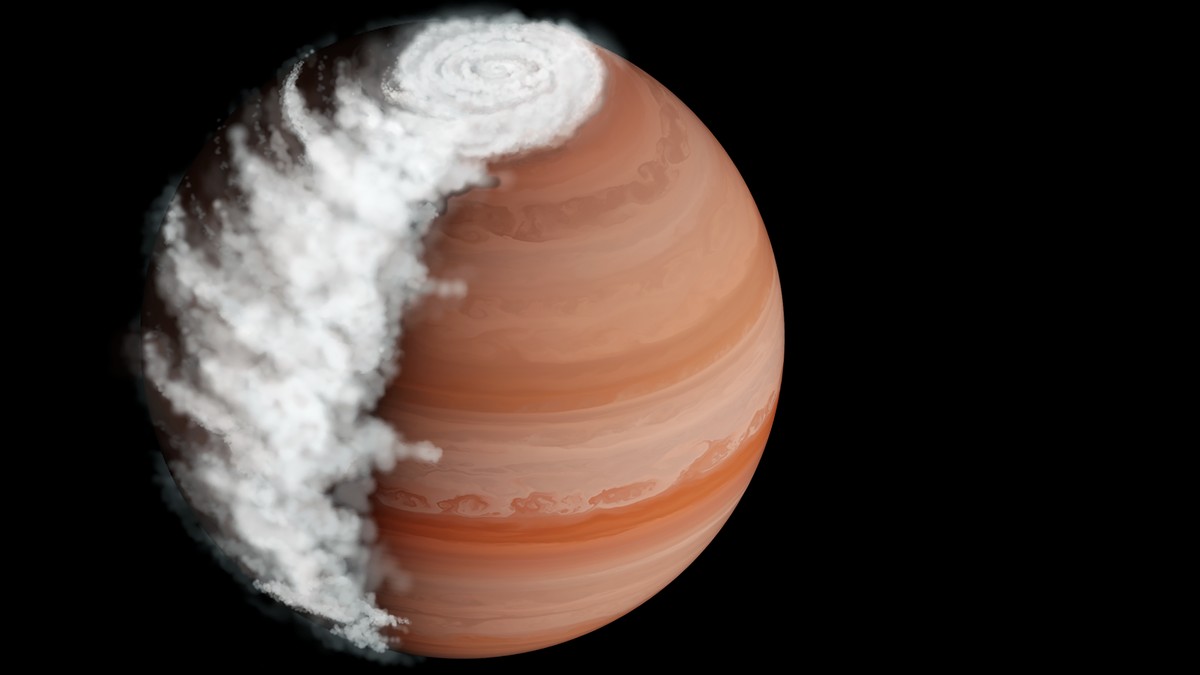
It’s cloudy in the morning. Clear by night.
Weird? For WASP-94a b, it’s standard procedure.
Located 700 light years from Earth this gas giant was found over ten years ago. Nobody could see it well. Now NASA’s James Webb Space Telescope has given us our first actual weather report for the place. It’s messy. And useful.
The Method
We can’t snap a picture of this planet. Too far away. Too faint against its star. So we watch the shadows. The planet crosses its star’s face every four days. This is called a transit.
As it passes we watch the star’s light dip. That dimming tells us the size. But here’s the trick. We look at the light passing through the planet’s upper atmosphere as it sets behind or rises in front of the star. The atmosphere drinks up certain colors of light.
The chemicals left behind are like a fingerprint.
Usually thick clouds mess this up. They block everything. Just white noise.
But WASP-96a b (wait, 94a b) is tidally locked. It spins with its orbit. One side burns in eternal daylight. The other freezes in endless night. Like our Moon but hotter. And closer. Much closer.
Two Worlds in One
This alignment lets scientists look at two different edges separately. The leading “morning” edge and the trailing “evening” edge.
JWST checked them both.
The difference was stark.
The morning side is packed with puffy clouds.
The evening side is clean. Almost bare.
These aren’t your grandma’s water-vapor clouds. We’re talking about magnesium silicate. Iron. Magnesium sulfide.
Vaporized rock. Literally molten stuff condensing in the air.
Sagnick Mukherjee from Arizona State University led the study. He was surprised. Not just by the clouds. By the gap.
“It was really surprising how different two halves of the same planet are,” he said.
His point: If we assume weather is uniform we get bad data. We can’t measure the composition right if we ignore the forecast.
Wind and Fog
Why the split?
Winds.
Massive temperatures differences between day and night create powerful jet streams. They push air around. Clouds form in the cool night. Then they rush toward the morning. The heat burns them off.
Like morning fog clearing under a sunrise. But the fog is liquid metal.
Doesn’t sound poetic?
“It’s just beautifully clear in the data.”
Heather Knutson at Caltech wasn’t involved but she knows data. She sees the difference instantly.
Why It Matters
Exoplanets aren’t static balls. They breathe. They have patches.
We used to use simple models. Assume one average temperature. One average cloud cover.
That gets you wrong answers.
“We know many exoplanets have clouds and clouds really don’t like being uniform,” Knutson noted.
You can’t just look at one part and guess the whole. Not anymore. The data demands better maps. Better respect for the chaos.
What else are we missing because our models were too simple?
Who knows.
We’ll keep looking. The telescopes are just getting started.