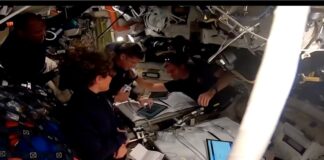
After a historic 10-day journey around the Moon, the Artemis II crew has safely returned to Earth. The mission concluded on Friday evening with a successful splashdown in the Pacific Ocean, marking a significant milestone in humanity’s renewed efforts to explore deep space.
The Final Descent: A High-Stakes Reentry
The return journey was a feat of extreme engineering. The Orion spacecraft—affectionately nicknamed “Integrity” by the crew—entered Earth’s atmosphere at a staggering speed of nearly 25,000 miles per hour.
To survive this descent, the capsule had to endure intense thermal stress:
– Extreme Heat: Temperatures reached approximately 5,000 degrees Fahrenheit (2,760 degrees Celsius).
– Plasma Blackout: As the spacecraft plummeted, superheated plasma enveloped the craft, causing a predictable six-minute communication blackout with Mission Control in Houston.
– Deceleration: Once the capsule dropped below 35,000 feet, a series of parachutes deployed, slowing the craft from orbital speeds to a gentle 19 miles per hour.
As Artemis II flight director Jeff Radigan noted, the reentry phase is a critical window where “everything has to go right.”
Mission Success and Crew Recovery
The crew, consisting of NASA astronauts Reid Wiseman, Christina Koch, and Victor Glover, alongside Canadian Space Agency astronaut Jeremy Hansen, arrived safely off the coast of San Diego, California, at approximately 8:07 P.M. EDT.
Following the splashdown, the astronauts were retrieved by helicopter and transported to the USS John P. Murtha. NASA officials confirmed that all four crew members are healthy and in excellent condition. The crew is now expected to travel to the Johnson Space Center in Houston to reunite with their families.
Why This Mission Matters
The successful completion of Artemis II is more than just a technical triumph; it is a foundational step for the next era of space exploration.
While previous missions have focused on low-Earth orbit (such as the International Space Station), Artemis II represents a leap toward sustained lunar presence. By testing the Orion spacecraft’s ability to protect humans during high-speed reentry and managing life support over a 10-day period, NASA is proving that the hardware and protocols necessary for long-term Moon missions—and eventually Mars—are viable.
“This is a perfect descent for Integrity,” stated NASA public affairs officer Rob Navias, highlighting the seamless execution of the mission’s final phase.
Conclusion
The successful return of the Artemis II crew validates the safety and reliability of the Orion spacecraft for deep-space travel. This mission serves as a vital bridge between current orbital capabilities and the future goal of establishing a permanent human presence on the Moon.