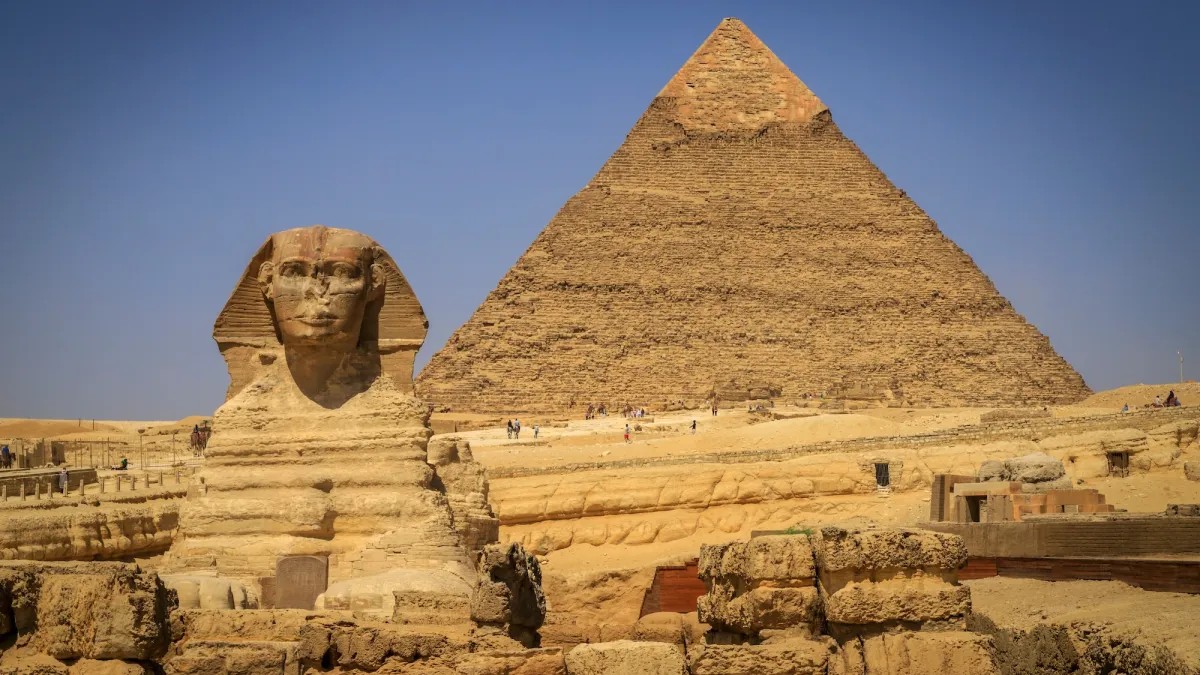
The Great Pyramid of Giza isn’t just old.
It’s stubborn.
Completed between 4600 and 4450 years ago it stands tall while the desert sands bury everything else. Earthquakes don’t bother it. They really don’t. The 1847 quake hit with a magnitude of 6.8. The 1992 tremor came in at 5.8. Both shook the region to its foundations. The Pyramid stayed put. Other quakes likely hit in centuries before instruments could measure them but the stones didn’t move.
So why?
Asem Salama from Egypt’s National Research Institute of Astronomy or Geophysics wanted to know. He is a seismologist. He has pondered this for years.
“The pyramid fascinates me because it marries monumental size with surprising stability over time.”
That quote sums it up. Salama and his team needed hard data. They wanted quantitative measurements. Not just theories. So they recorded ambient vibrations right on site. Their findings appeared today in Scientific Reports. The answer wasn’t magic. It was iteration. Centuries of trial and error.
“They experimented. Early attempts failed. They learned. They refined the designs until they were stable and effective.”
Salama points to the history books. Or rather the ruins. Early Egyptian buildings were simple mastabas. Roughly 3100 BCE. Then came the Step Pyramid at Saqqara around 2650 BCE. Stacked layers. Then the Bent Pyramid at Dahshur circa 2500 BCE. It bent. Hence the name. Not every project worked. Many collapsed. But the builders watched what fell apart and fixed it for next time. They nailed the slope angles eventually.
By the time they built the Great Pyramid the technique was polished. Salama’s team measured 37 spots. Inside. Outside. Soil. Stone chambers.
Here is what happened.
Seventy-six percent of vibrations inside the pyramid hit between 2.0 and 2.6 hertz. Stress spread evenly. No weak points. The surrounding soil vibrated at only 0.6 hertz. A big difference.
Think about it.
When the ground shakes it vibrates at its own frequency. The building vibrates at another. If they match things amplify and structures fail. If they mismatch the building sits out the worst of it. The pyramid’s frequency differs sharply from the soil’s. The soil quakes. The pyramid stays calm.
Also the bedrock helps. Limestone foundation. Solid base. Less risk of damage from below.
Inside matters too. The Subterranean Chamber carved straight into bedrock showed no boosted frequencies. That makes sense. Stone against stone. As you go up readings changed. They peaked in the King’s Chamber high above. But wait.
The Relieving Chambers sit on top. They actually lower the amplification. Lower than the King’s Chamber below. Intentional?
Hard to say.
“We must separate observed resilience from modern intentional design.” Salama is cautious here. He doesn’t think ancient engineers had a formal theory of earthquake dynamics. No equations. No blueprints for seismic loads as we know them today.
Did they care?
Probably not directly.
But their intuition was sharp. They built for balance. Durability. Awe. The earthquake resistance? A byproduct. A happy accident of good geometry and stubborn stone.
Is it an accident when it works so well for thousands of years?
“It evolved over generations. Best practices that improved balance and long-term survival.”
We still haven’t matched it in some ways. Modern engineering chases these goals but the Pharaohs’ intuition holds up. Extraordinary monuments built on trial error and an uncanny feel for stability.
What do you build next?
Maybe something that lasts.