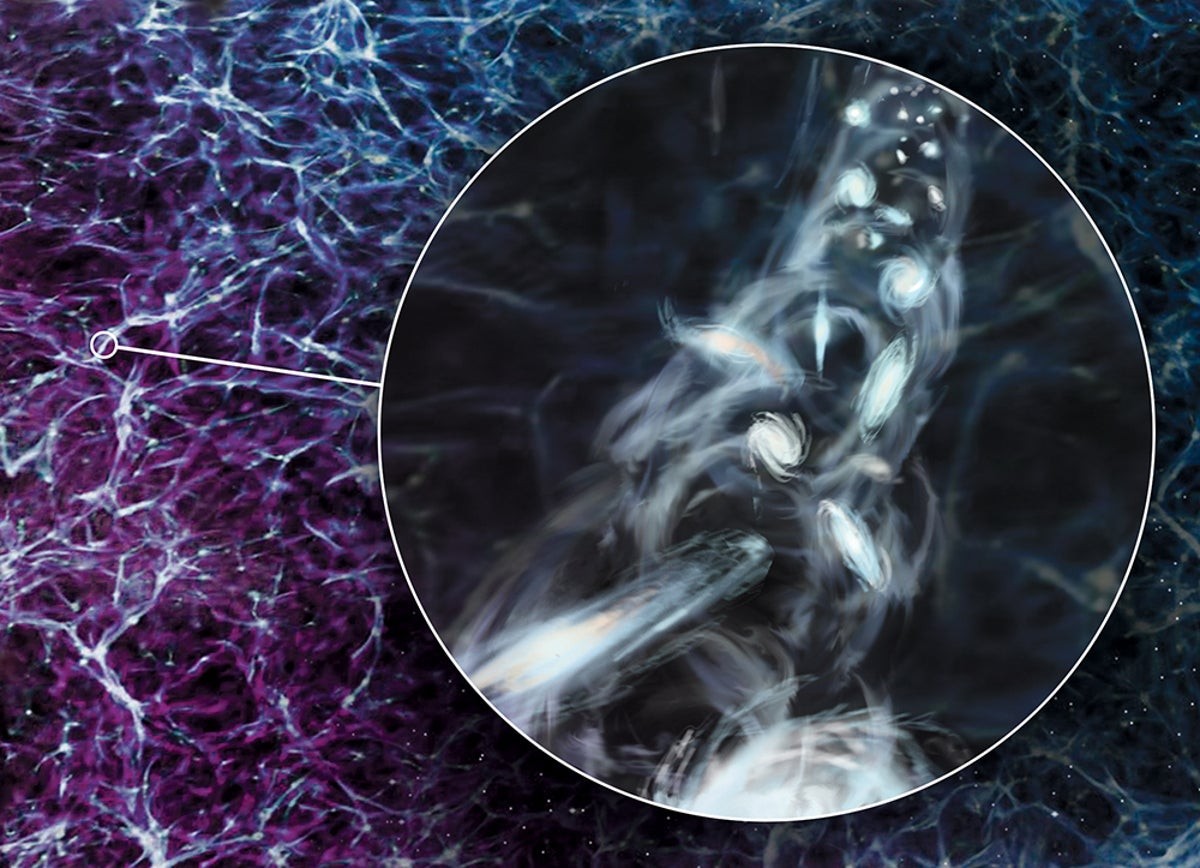
Astronomers have identified one of the largest rotating structures ever observed in the universe: a colossal chain of galaxies embedded within a spinning cosmic filament approximately 400 million light-years from Earth. The discovery, published in Monthly Notices of the Royal Astronomical Society, provides a new window into the formation, evolution, and distribution of galaxies.
The Cosmic Web and Filament Rotation
Galaxies aren’t randomly scattered; they are organized into vast networks known as filaments, interconnected by dark matter. These filaments, along with empty voids and dense galaxy clusters, constitute the “cosmic web” that defines the large-scale structure of the universe. Filaments act as conduits for matter, channeling material towards galaxies and clusters as the universe expands. Studying these structures helps scientists understand how galaxies acquire their spin and how the universe itself evolved.
Recent observations suggest that some filaments rotate, but this new study provides the most detailed evidence yet. Using the MeerKAT radio telescope in South Africa, astronomers examined a filament 50 million light-years long containing over 280 galaxies. Within this structure, they found 14 hydrogen-rich galaxies aligned in a thin, 5.5-million-light-year chain.
Unexpected Synchronized Rotation
What surprised researchers was not only the spin of individual galaxies within the filament but also the synchronized rotation of the entire structure itself. The filament spins at approximately 110 kilometers per second—a phenomenon never before observed on this scale. “I started doubting if it was real or if I did something wrong in the analysis,” says Lyla Jung, the lead astronomer from the University of Oxford.
Detecting this faint signal required careful data collection and modeling to avoid false positives from overlapping objects. The findings confirm that filaments can exhibit coordinated rotation, challenging previous assumptions about the behavior of large-scale cosmic structures.
Implications for Dark Matter Research
The discovery has broader implications for understanding dark matter, a mysterious substance that makes up a significant portion of the universe’s mass. Measurements of galactic rotation have long provided some of the strongest evidence for dark matter’s existence. Analyzing filament rotation could reveal how much dark matter resides within these structures, offering a new method for mapping its distribution across the cosmos.
The observed filament appears to be actively growing, with many of its galaxies still rich in hydrogen fuel for star formation. This suggests that it continues to accrete material, providing ongoing insights into how galaxies evolve within these large-scale cosmic structures.
This discovery underscores the dynamic nature of the universe’s largest structures and opens new avenues for research into the interplay between galaxies, dark matter, and the cosmic web.