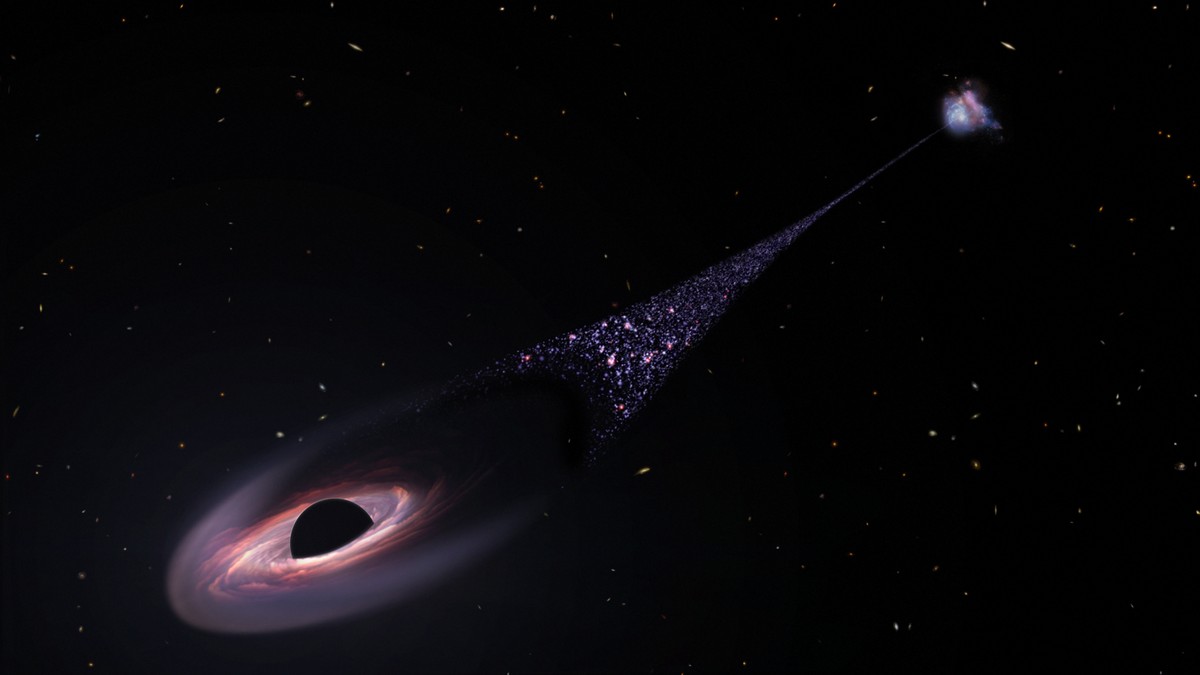
A potentially unprecedented astronomical object, dubbed RBH-1 (for “runaway supermassive black hole”), has sparked a debate among astronomers. The object appears to be hurtling through intergalactic space at over three million kilometers per hour, raising the possibility of an ejected black hole tens of millions of times the mass of our Sun. However, the nature of RBH-1 remains uncertain: some scientists argue it’s a rogue black hole, while others believe it’s an extraordinarily flat, edge-on galaxy.
The Discovery and Initial Claims
RBH-1 was discovered serendipitously during routine Hubble Space Telescope observations of a distant dwarf galaxy. Astronomers noted a long, linear streamer of light approximately 200,000 light-years long – about twice the width of the Milky Way. Spectral analysis revealed a structure composed of gas and stars, with a bright knot at one end emitting light equivalent to 50 million suns.
The initial interpretation proposed that RBH-1 is a supermassive black hole ejected from its host galaxy, trailing material as it moves through intergalactic space. Such ejections are theoretically possible during galaxy collisions, where misaligned spins or three-way interactions can impart tremendous momentum to a merged black hole. The idea isn’t far-fetched: black holes can be kicked out of galaxies after mergers if the energy released during the event isn’t symmetrical.
The Counterargument: A Rare Galaxy Shape
However, another team of astronomers challenged this interpretation. They argued that the observed structure could instead be an exceptionally flat, “bulgeless” galaxy seen edge-on. These galaxies are rare but not unknown, and when viewed from the side, they would appear as a thin line. The team pointed out that a runaway black hole would struggle to create the observed wake of star formation, and the timeline seemed too short for so many stars to have formed in the wake.
New Data, Continued Debate
Recent observations from the James Webb Space Telescope (JWST) have intensified the debate. The original discovery team analyzed infrared spectra, finding a significant velocity change in the gas at the structure’s tip – consistent with a hypersonic black hole creating shock waves. The dissenting team, also analyzing the JWST data, argued that the spectral signature aligns better with standard star-forming galactic gas clouds, reinforcing the galaxy hypothesis.
Why This Matters
The case of RBH-1 highlights the challenges of interpreting faint, distant astronomical phenomena. If confirmed as a runaway black hole, it would be a rare and powerful example of gravitational ejection, offering insights into galaxy mergers and black hole dynamics. On the other hand, if it’s a unique galaxy, it could challenge our understanding of galactic formation and evolution.
The back-and-forth between astronomers is a hallmark of good science. Disagreement, careful analysis, and the pursuit of more data refine our understanding of the universe. As of now, the true nature of RBH-1 remains unknown, but ongoing research will continue to push the boundaries of our knowledge.
The cosmos remains full of surprises, and RBH-1 stands as a reminder that even in the age of advanced telescopes, mysteries persist.