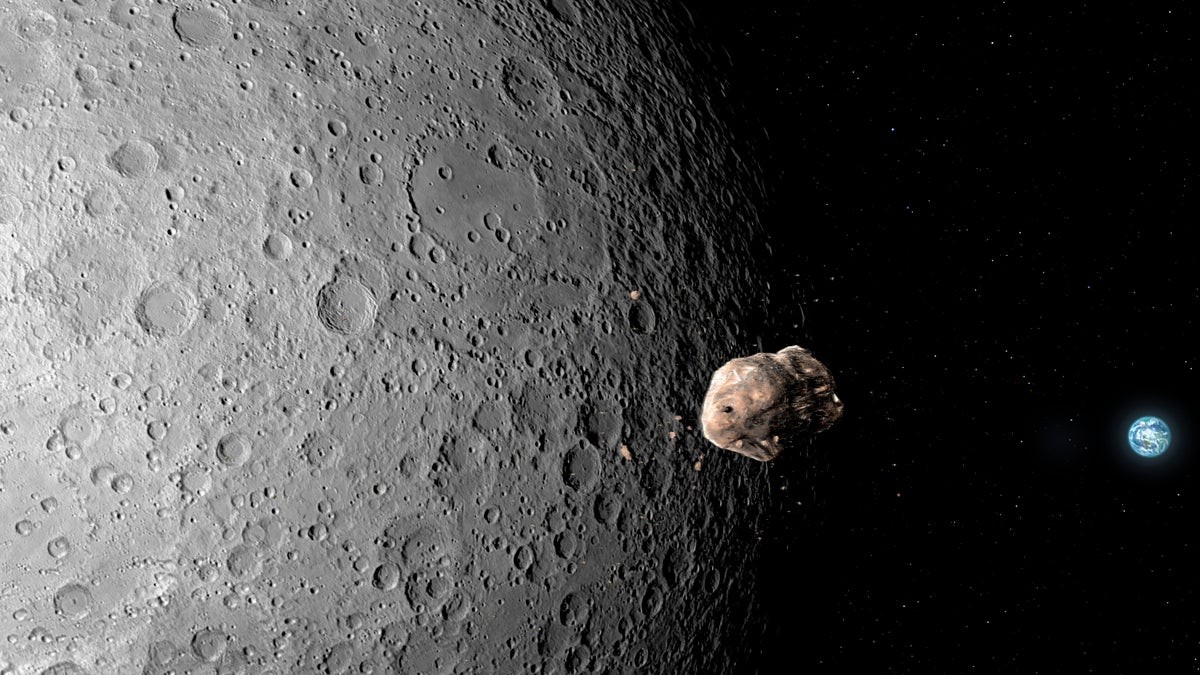
A recently discovered asteroid, 2024 YR4, initially posed a significant threat to both Earth and the Moon. However, new observations from the James Webb Space Telescope (JWST) confirm it will safely miss our planet’s celestial companion by approximately 21,200 kilometers. This revelation avoids a potentially disruptive event that could have damaged critical Earth-orbiting satellites.
From High Risk to Safe Passage
Discovered in late 2024, 2024 YR4 quickly became the most dangerous asteroid ever tracked. Early calculations indicated a 3.1% chance of hitting Earth in 2032, which would have unleashed devastating force on any city in its path. Later analysis shifted the threat to the Moon, with a 4.3% probability of impact on the same date. The stakes were high: a lunar collision could have ejected debris into Earth’s orbit, jeopardizing valuable communication satellites.
The Role of the James Webb Telescope
The JWST, designed for deep-space observation, unexpectedly played a crucial role in assessing the asteroid’s trajectory. Its infrared capabilities allowed astronomers to track 2024 YR4 when it was 450 million kilometers away—a feat impossible for other telescopes. The telescope confirmed the asteroid’s size at 60 meters, confirming it was large enough to cause substantial damage.
“We think this is certainly the faintest solar system object that has ever been observed,” says Andy Rivkin, a planetary defense researcher at Johns Hopkins Applied Physics Laboratory.
Why This Matters
This incident underscores the growing need for improved planetary defense systems. Had the asteroid’s trajectory remained unchanged, experts would have faced a severe time crunch to implement mitigation strategies, such as deflection or destruction. The short timeframe would have left limited options, including risky solutions like nuclear intervention.
The discovery highlights the importance of advanced telescopic surveillance. The upcoming NASA Near-Earth Object Surveyor and the Vera C. Rubin Observatory are expected to identify countless additional potentially hazardous asteroids in the coming years. This underscores the ongoing, urgent need for rapid and accurate threat assessment.
A Future of Vigilance
While 2024 YR4 no longer poses an immediate threat, experts emphasize that this is not a one-off event. “We are prepared to face any future threats,” says Juan Luis Cano of the European Space Agency’s Near-Earth Object Coordination Center, “And they will come.” The JWST’s success in tracking this asteroid demonstrates the value of versatile technology in planetary defense, ensuring that we can respond effectively to future cosmic risks.