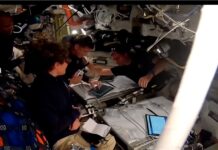
The Artemis II mission has officially transitioned from its lunar exploration phase to its return journey to Earth. After completing a complex flyby of the Moon’s far side, the crew of the Orion spacecraft—Victor Glover, Jeremy Hansen, Christina Koch, and Reid Wiseman —is now under the gravitational influence of Earth, heading toward a scheduled splashdown this Friday.
Capturing the Moon: A Visual Legacy
Following a high-intensity schedule of scientific tasks during the lunar encounter, the crew entered a period of rest on day seven of the 10-day mission. During this time, NASA began releasing a massive cache of data collected during the flyby, totaling over 175 gigabytes of high-resolution imagery.
The released photographs offer unprecedented views of the lunar landscape, including:
– Detailed crater topography showing extreme relief across the Moon’s surface.
– A unique solar eclipse viewed from a lunar perspective.
– An “Earthrise” image, which many are comparing to the legendary photographs taken during the Apollo 8 mission.
This data is more than just beautiful imagery; it provides critical geological context that will inform future landing sites and scientific studies of the lunar surface.
Connecting Space: A Historic Communication Milestone
The mission also achieved a significant milestone in space communications. The Orion crew participated in the first-ever “ship-to-ship” audio call between a lunar mission and the International Space Station (ISS).
During the call, Christina Koch—an experienced astronaut who has previously lived on the ISS—spoke with her colleague Jessica Meir. This exchange highlighted the profound isolation of deep-space travel, as the crew discussed the vastness of the void surrounding Earth when viewed from the lunar vicinity.
Technical Challenges: The Waste Management Issue
While the scientific achievements have been stellar, the mission has faced practical, albeit unglamorous, difficulties. The spacecraft, nicknamed Integrity by the crew, has experienced recurring failures with its space toilet—the first of its kind to fly on a lunar mission.
The malfunction has forced the astronauts to rely on backup collapsible plastic containers for relief. While initial theories suggested a frozen vent was blocking waste disposal, NASA Flight Director Rick Henfling noted that warming the vent in sunlight did not resolve the issue. The current working hypothesis is that debris from an antimicrobial chemical reaction in the wastewater is clogging a filter.
Preparing for the Final Descent
As the spacecraft exits the Moon’s sphere of influence, the crew is shifting their focus to safety and reentry preparations. The final days of the mission will involve several critical protocols:
- Radiation Shelter Drills: The crew will practice constructing emergency shelters by stacking stowage items against the capsule’s walls. This is a vital skill for protecting astronauts from solar radiation, a necessity for future long-duration missions to Mars.
- Manual Piloting Tests: The crew will practice manual maneuvers, such as tilting the Orion capsule to shield the viewport from the sun or aligning it with specific celestial bodies.
- System Checks: Final testing of the Integrity spacecraft and all in-flight safety systems.
The Road to Splashdown
The mission is now entering its most high-stakes phase: atmospheric reentry. NASA Administrator Jared Isaacson noted the inherent tension of this stage, stating that the mission’s success is only truly secured once the crew has successfully deployed parachutes and reached the water.
The Artemis II crew is scheduled to splashdown on Friday at 8:07 P.M. EDT.
The successful completion of this mission will mark a pivotal moment in human spaceflight, proving our ability to navigate the deep-space environment and providing the technical data necessary for the next era of lunar and Martian exploration.