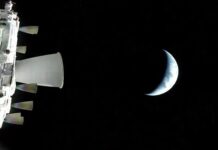
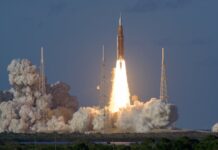
NASA’s Artemis II mission, the first crewed lunar voyage in over half a century, is proceeding as planned. As of Friday morning, the Orion spacecraft is approximately 88,000 miles from Earth and 170,000 miles from the Moon, traveling at roughly 4,260 miles per hour. The mission marks a pivotal moment in space exploration, signaling a renewed commitment to lunar missions after a long hiatus.
Translunar Injection Burn Completed
The critical translunar injection (TLI) burn, executed on Thursday at 7:49 PM EDT, successfully accelerated the spacecraft to 22,670 miles per hour. This maneuver placed Orion on a “free return trajectory,” meaning it will swing around the far side of the Moon before returning to Earth on April 10. This trajectory relies on gravitational forces for much of the journey, minimizing fuel expenditure.
“From this point forward, the laws of orbital mechanics are going to carry our crew to the moon, around the far side and back to Earth,” stated Lori Glaze, NASA’s acting associate administrator for Exploration Systems Development.
This approach is efficient but also means the spacecraft won’t enter a stable lunar orbit. Instead, it will use the Moon’s gravity to slingshot back toward Earth.
Astronaut Activities and System Checks
The crew—Reid Wiseman, Victor Glover, Jeremy Hansen, and Christina Koch—have begun conducting essential tests and demonstrations. They tested Orion’s flywheel exercise machine, crucial for maintaining muscle mass in zero gravity, though Wiseman’s use of it caused minor wobbling in the live feed. The crew also addressed a minor fault with the spacecraft’s toilet system, quickly resolved by Koch, who humorously took on the role of “space plumber.”
Preparations for Lunar Flyby and Return
Over the next several days, the astronauts will perform further checks to ensure the mission remains on course. Planned activities include CPR demonstrations, medical kit assessments, and testing the emergency communications system, which relies on NASA’s Deep Space Network for continuous connectivity.
The Artemis II mission isn’t just about reaching the Moon; it’s a full-scale operational test of the hardware and human endurance needed for sustained lunar exploration. The crew’s focus on both scientific demonstrations and basic life support functions underscores the complexity of long-duration spaceflight.
The success of this mission will validate key technologies and procedures for future Artemis missions, including eventual lunar surface landings. As Glaze noted, the crew has “eight days of work ahead,” setting the stage for a new era of human space exploration.