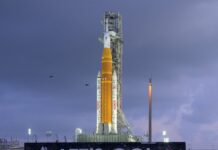
The Artemis II mission, slated to launch as early as tonight, marks a pivotal step in humanity’s return to deep space exploration. The four astronauts aboard the Orion spacecraft will embark on a 10-day journey, circumnavigating the Moon in an ambitious test flight that pushes the boundaries of modern space travel.
The Mission’s Trajectory
Unlike Apollo missions that landed on the lunar surface, Artemis II will follow a figure-eight trajectory around Earth and the Moon. This path takes the crew close to the lunar far side – the hemisphere permanently facing away from Earth – before utilizing Earth’s gravity to slingshot them back home. The mission isn’t about landing; it’s about proving the Orion spacecraft and Space Launch System (SLS) rocket can safely carry humans to and from deep space.
Key Stages of the Flight
The first 24 hours after launch are dedicated to achieving a stable high Earth orbit. Then comes the “translunar injection burn” on day two: a critical engine firing that accelerates Orion toward the Moon. Over the next two days, minor course corrections will refine their trajectory, preparing them for the most distant point of the mission.
- Day Five: Orion enters the Moon’s gravitational influence, but remains in a flyby trajectory.
- Day Six: The crew reaches the lunar far side, briefly losing direct radio contact with Earth. This phase could potentially break the record for the farthest distance traveled from our planet, previously held by Apollo 13 in 1970.
- Observation and Imagery: The crew will conduct visual observations and capture unique imagery, including potential new views of “Earthrise” – Earth appearing as a vibrant jewel above the desolate lunar landscape. At its closest approach, the Moon will appear as large as a basketball held at arm’s length.
Why This Matters
Artemis II is not merely a repeat of past lunar missions. It’s a foundational test for the Artemis program, which aims to establish a sustained human presence on and around the Moon. Success here paves the way for Artemis III, scheduled to land astronauts near the lunar south pole as early as 2026.
This mission confirms the viability of the SLS rocket and Orion spacecraft, which will be essential for future deep space exploration, including potential crewed missions to Mars.
The Artemis program represents a shift towards long-term lunar infrastructure, including a lunar base camp and Gateway space station. Artemis II is the first step toward realizing this vision, proving that humans can once again venture beyond Earth orbit and prepare for a new era of space exploration.