Jupiter experiences lightning that is 100 times more powerful than Earth’s, according to recent research published in the journal AGU Advances. This discovery not only highlights the extreme conditions on the gas giant, but could also provide valuable information about our own planet’s atmospheric electricity.
Stupnice jovianských bouří
Earth’s lightning, already a powerful force capable of starting forest fires and disrupting power grids, pales in comparison to Jupiter’s electrical storms. While Earth sees hundreds of millions of lightning strikes annually, lightning events on Jupiter occur on a completely different scale. Jeho bouře – některé větší než samotná Země – zuří po staletí a generují obrovské výboje.
The Great Red Spot, a centuries-old anticyclonic storm, is more than 16,000 kilometers wide and supports winds of 320 km/h. These colossal weather systems produce countless amounts of lightning, many of which are significantly stronger than anything ever seen on Earth.
Jak Juno odhalila pravdu
Over the years, spacecraft observing Jupiter have detected these intense electrical flashes, but they were usually observed on the night side, leading scientists to question whether Jupiter regularly produces such powerful lightning or whether weak strikes also occur.
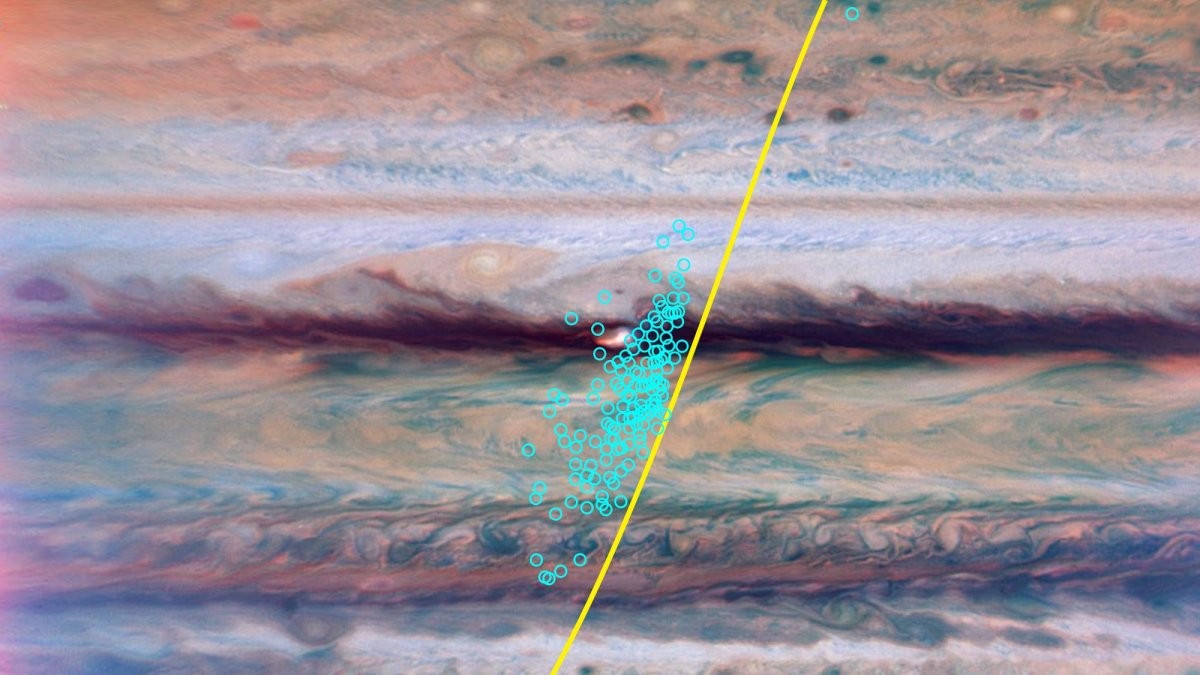
The Juno spacecraft, orbiting Jupiter since 2016, has changed that. Using its microwave radiometer, Juno can detect radio emissions from lightning with unprecedented accuracy. Recent observations during a quiet period in the Northern Equatorial Belt have allowed researchers to pinpoint individual storms and measure their severity.
Data: Energetické úrovně přesahující úrovně na Zemi
Juno recorded microwave static electricity at approximately three pulses per second, including one incident with 206 pulses. Analysis of 613 bursts revealed a wide range of energy levels: some comparable to Earth’s lightning, others at least 100 times more powerful. Other calculations suggest that lightning on Jupiter could contain 500 to 10,000 times more energy than a typical Earth strike.
Proč je Jupiterův blesk tak extrémní
Klíčovým rozdílem je atmosféra Jupiteru. Unlike Earth’s nitrogen-rich environment, Jupiter’s clouds are composed primarily of hydrogen, which is much heavier. This means that it takes more energy to lift moist air in Jovian storms. Once this happens, the resulting discharges are huge.
Scientists are studying whether this difference in atmospheric composition or the higher altitude associated with Jupiter’s taller storms is due to the extreme power of its lightning. The research could help us understand the fundamental mechanics of lightning, improving our forecasting and protection against severe weather events on Earth.
The study highlights how little we still know about lightning, even on our own planet. Jupiter’s extreme conditions offer a natural laboratory to study this phenomenon in conditions far beyond what we can replicate on Earth.